Italy, 1814
Word of Inspiration: Gratitude
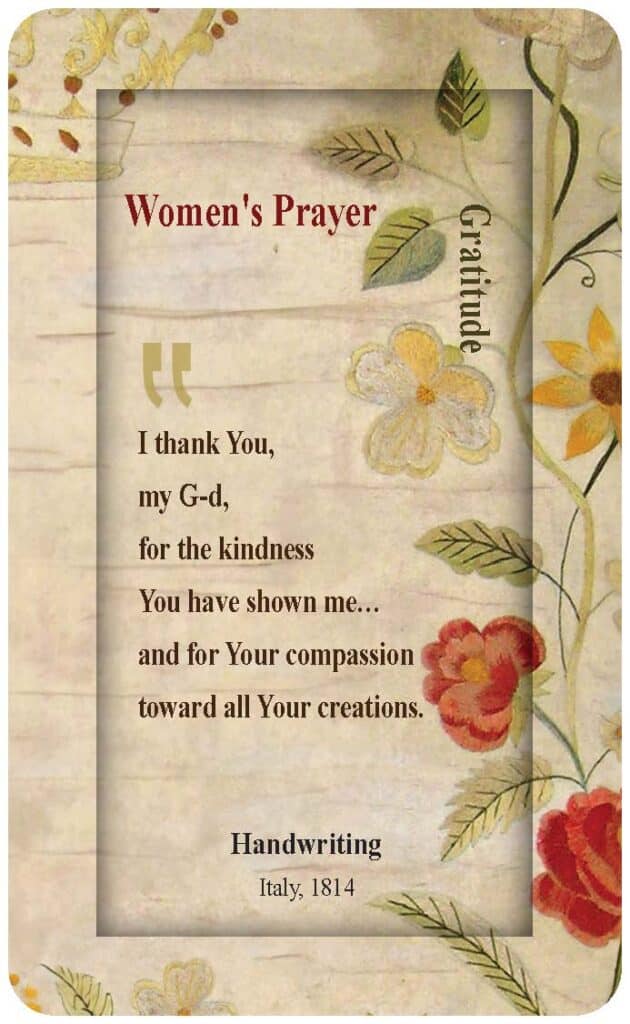
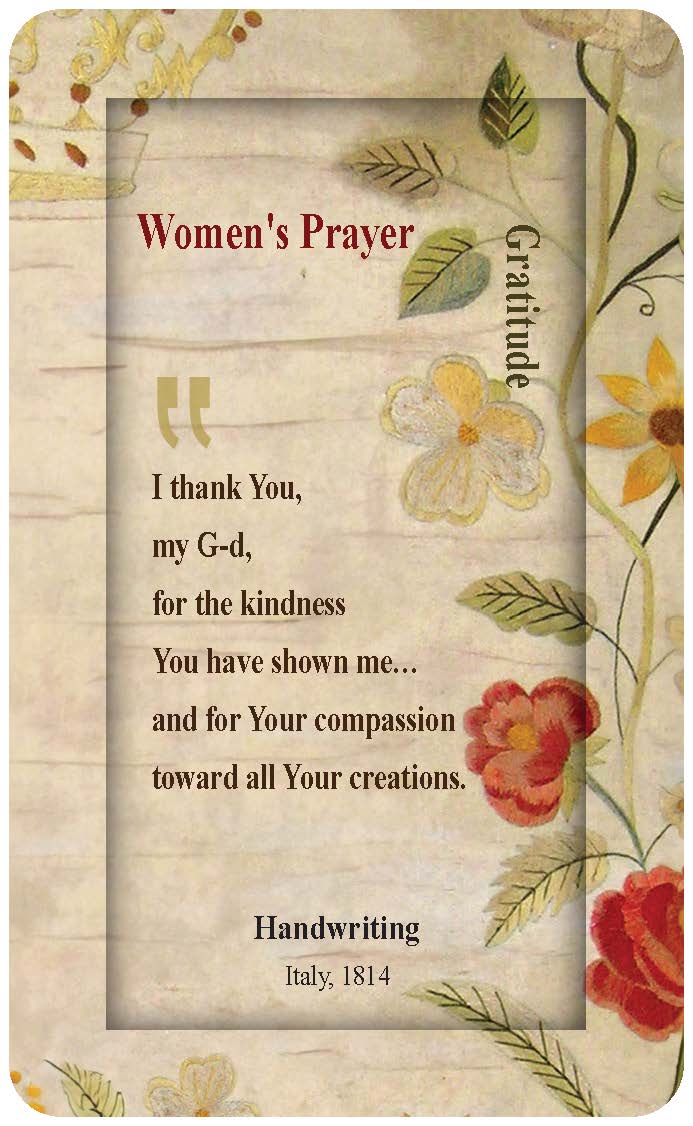
The prayer “I thank You, my G-d” (“Modet ani lefanecha” ) is taken from a personal prayer book written especially for Sarah, wife of Hezekiah Levi, in Italy in 1814. The prayer books of Jewish women in Italy are works of art, handwritten in Hebrew by skilled scribes. Husbands, and sometimes fathers, would gift these prayer books, some decorated with colorful illustrations, fine papers, silver embossing and leather bindings, as gifts of love, spirit and appreciation.
Within the pages of this ancient prayer book lies a prayer that expresses gratitude not only for what has already happened but also for what is still just a hope. The word “modet” appears here exactly as in the original. It is not a modern addition, but living evidence of the feminine form in Hebrew, present and precise. Many women in the communities of Italy knew Hebrew and prayed as part of the public. This was an uncommon reality overall and especially in comparison to what is custom in other Jewish communities.
This prayer is a testimony to a spiritual life experience, preserved within a rich
and unique tradition.
Modet – a first breath, a first word, a first expression of gratitude.
A daily reminder that good exists and that it is possible to begin again every morning, every time.
Where does this meet you?
The word “modet” (I give thanks, female conjugation) invites a beginning. A beginning of a day, of movement, of thought.
This is a prayer fitting for moments of awakening in every sense: opening your eyes in the morning, taking a breath after a storm, or when something inside
you becomes clear.
“Modet” allows you to pause, reflect, notice the good that is already present, give thanks and look up and look ahead with faith and hope.
When you’re seeking grounding, when you want to remind yourself of your very presence in the world and that there is something to be thankful for.
This card is suitable as an opening for meditation, mindful breathing, a conversation with yourself or with someone particularly close.
A single feminine word “modet” contains an entire world.