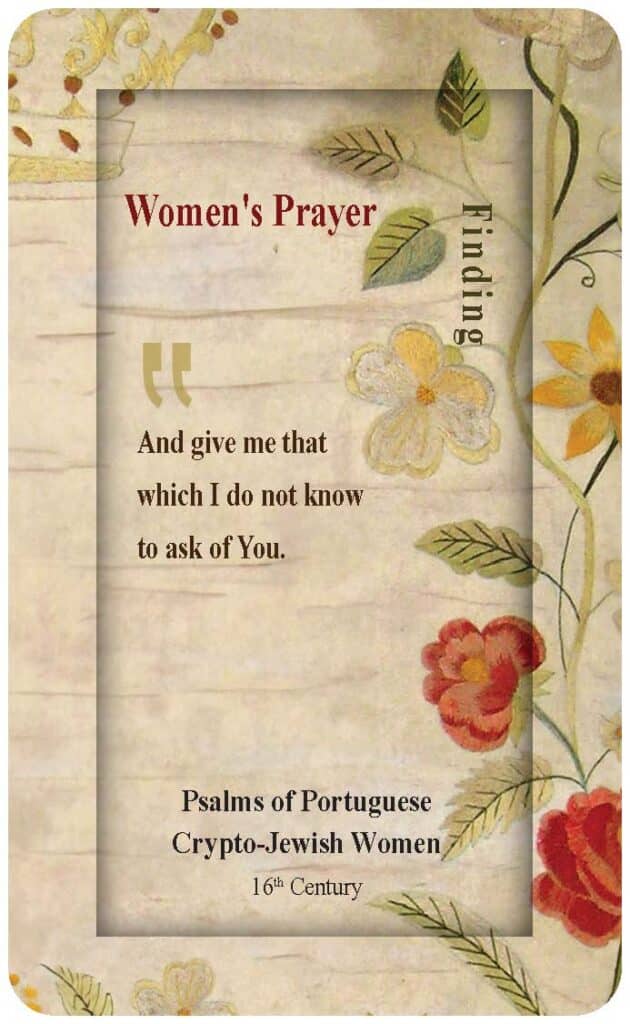
“And give me that which I do not know to ask of You”.

Word of Inspiration

Time and Place

Prayer Content

Rare Judaica Item
Courtesy of the Gross Family

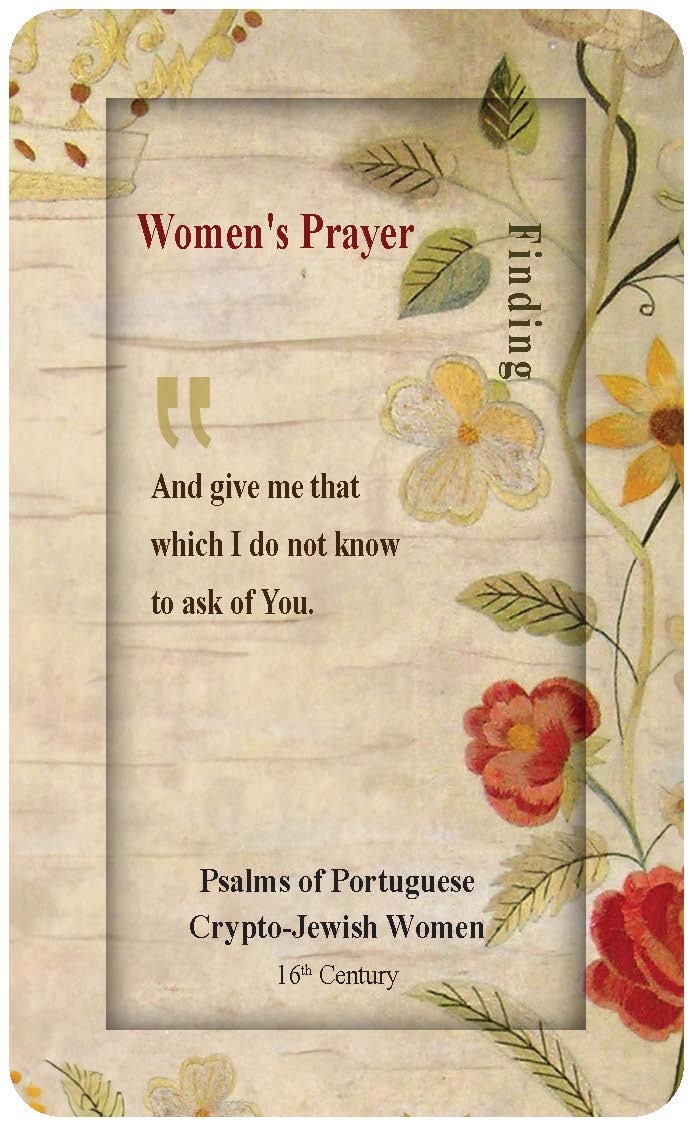
“And give me that which I do not know to ask of You”.

Prayer of Marrano Women | Portugal, 16th century
word of inspiration: Finding

After a period of spiritual and cultural prosperity in Spanish Jewry, darkness fell. The royal decree of Ferdinand and Isabella (1492) prohibited the practice of the Jewish faith and led to expulsion, persecution and severe decrees.

Many Jews fled Spain and thousands sought refuge in Portugal. Four years later, in 1496, King Manuel I forced both the longstanding Jews of Portugal and the refugees to convert. This was a forced conversion, accompanied by deception and fraud. The Jews were forced to live with a dual identity: Christians outwardly, Jews in secret.

The Inquisition, the interrogative institution of the Catholic Church, acted with a heavy hand, instilled constant fear and brutally persecuted any expression of Judaism. In the communities of the Marrano, women stood out. The circumstances of life in the Iberian Peninsula in the late 15th and 16th centuries pushed the observance of commandments from the public communal space into the secrecy of the home.

The women were the keepers of the Jewish flame and held a unique role in passing on the tradition to future generations. Behind closed walls, they lit candles behind shuttered windows, whispered prayers, kept customs and traditions and passed on memories from mother to daughter. Over the years, the knowledge gradually diminished, but the adherence to customs remained.

Testimonies collected in the early 20th century by Samuel Schwartz, a Jewish engineer from Poland who operated in Portugal, uncovered groups of descendants of Marrano, who carried within them fragments of customs and prayers without knowing their source, but with a deep inner sense of belonging.This card echoes a faint yet powerful voice of a hidden feminine prayer: “And grant me that which I do not know how to ask of You…” A prayer of trust that there is Someone who listens even when there are no words.
About the Image:

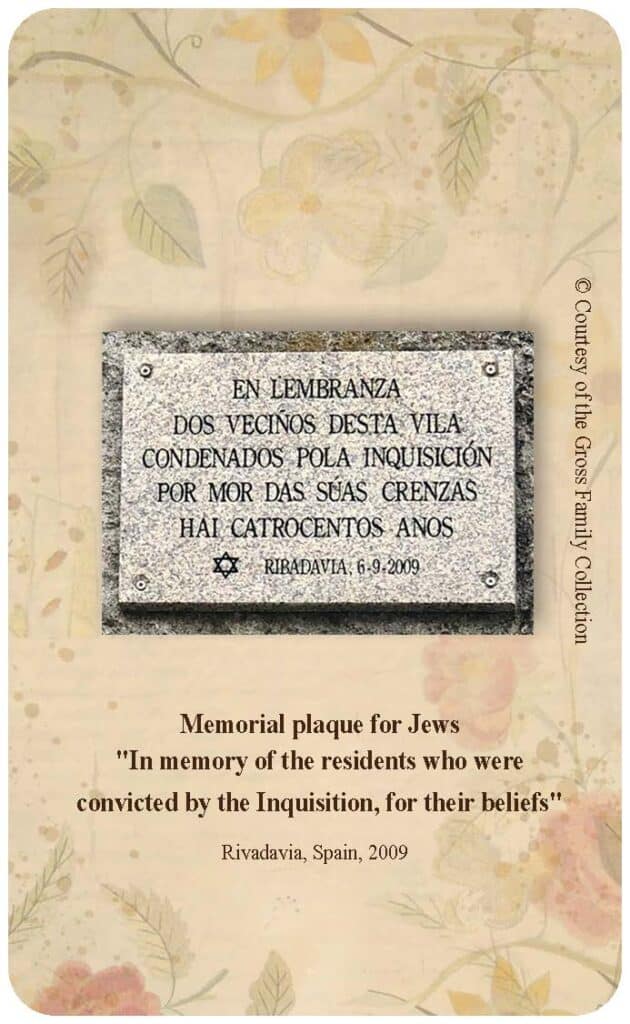
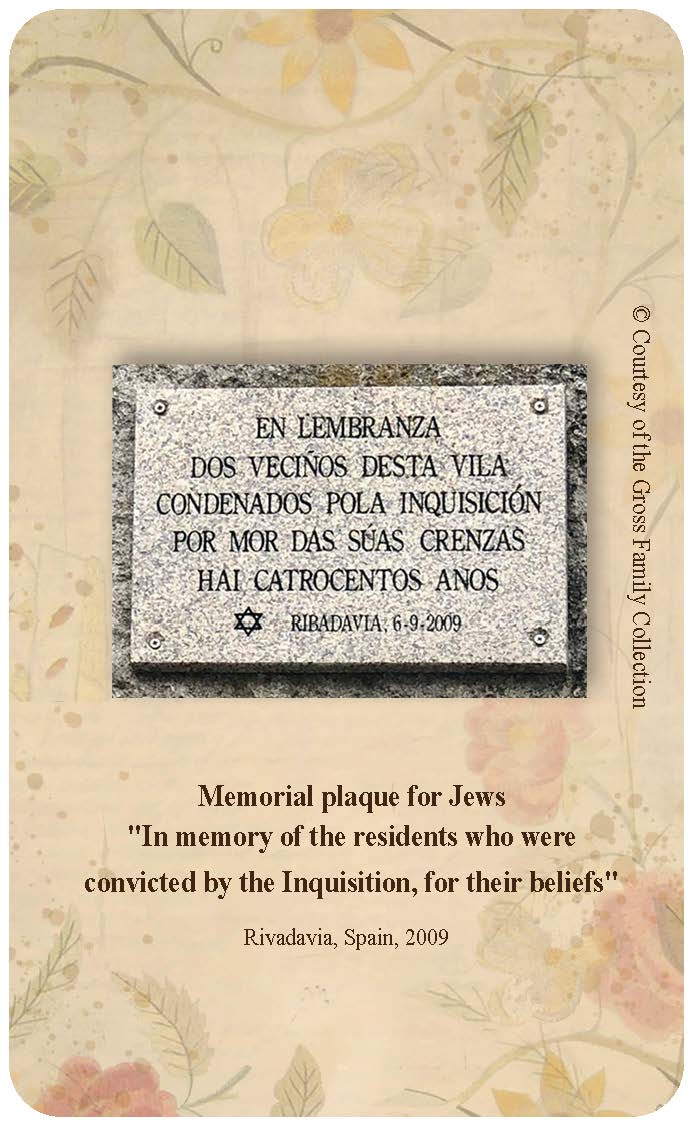
Memorial plaque of the Jews

On a stone wall in the town of Ribadavia, Spain, a small memorial plaque was placed in 2009 for the Jewish community that was extinct: “They were condemned for their faith.”
It was placed for the first time hundreds of years after the expulsion from Spain. Too late for those who lost everything, but not too late to remember.
The Jewish community of Ribadavia, like many others, was annihilated. Many emigrated, others were forced to convert.
Generations of Marrano Jews lived in fear, in split identity, in complete silence and only in 2009 did someone dare to place the words “They were condemned for their faith” on the wall.

This plaque is not merely a site marker, it is a testimony
to the story of the Jewish people.
A reminder that even if entire chapters were erased from the books,
they were engraved in our memory and continued to live on in our prayers.

And within this story stands the women’s Jewish school of the Marrano women. Women who carried the memory alone and kept the flame in secret.
They were the ones who lit candles behind closed shutters, who swept the house on Friday afternoon, who wore white on Shabbat as a hidden act of remembrance.
They were the ones who prayed in whispers, recited fragmented verses and believed with all their heart even when everything around them said otherwise.
Their story was not written, but it was passed down. And it is an inseparable part of our history.

Where does this meet you?

This prayer does not require prior knowledge or deep familiarity, only presence.
It touches on times when there are no words, but there is a deep emotion and a nameless longing.
The Marrano women teach us that even in times of uncertainty and in periods when words disappear, someone is still listening.
Hearing what the heart cannot say, understanding even the silence and accepting even what we did not dare to ask.

An Invitation to Reflect:

Try to think, what within you remains unspoken yet present?
Is there a prayer in you that has no words, but has a heart?
What is the grace you hope for, even without asking for it?

Inspiration for Using the Card:

The power of Women’s Prayer Cards in exploring identity, belonging and the search for meaning.

Personal Process

The card invites exploration of identity that is not always visible or conscious:
Jewish, feminine, hidden identity.
A question for personal reflection: What part of my identity am I scared to ask for space for?
Another question: When did I hesitate and who did I not ask of to see me,
perhaps even held within me fear of myself?

Discussion Circle

This delicate card invites us to look into the prayers that are unspoken yet live within us.
Suggestion for the circle: Each participant is invited to share “a prayer that has not yet found words.”
Another suggestion: Use an object that represents a lack or a longing,
or write a sentence beginning with “And grant me…”

Emotional and Therapeutic Work

To talk about moments when we lack words, direction or answers, but there is an open heart and a desire to receive from the world that which I do not know how to ask for.
When was the last time I felt I didn’t know what to ask for, and yet I asked or longed to speak?
Exercise: Write a letter to the Creator, to the universe or to yourself, allowing a general request  – even without knowing exactly what you are asking for.

To Deepen

More on the complex world of the Marrano women and the way they preserved their Judaism through secret prayers, hidden codes and a determined feminine tradition can be found in the A Jewish Woman’s Prayer Book, Women’s Customs and in the book Iconic Jewish Women about Dona Gracia, the Marrano who was called “Queen of the Jews”.

“Teach me, my God, to bless and to pray…
So that my day not become mere habit”

Leah Goldberg

Between Words and the Wisdom of the Heart

“At the end of every night the darkness disappears. May everyone merit to see the light.”

Liri Elbag, a surveillance soldier from the Givati Brigade who was kidnapped and held captive for 477 days by the terrorist organization Hamas, who became a symbol of resilience and faith, said that this sentence accompanied her during her time as a hostage.

Click me

Women’s Prayer Cards (Tefilat Nashim) We use cookies to ensure the website functions properly and improve user experience. You can choose which types of cookies to enable.
Cookie Selection


Join us for women's prayer

A connection to the Jewish story through women’s voices
Join to receive sources, prayers, rituals and stories from the Jewish female tradition.