Share:

Facebook
LinkedIn
WhatsApp

Louise Rothschild and the Jewish Female Network

What can a single dedication teach us about a female network of creativity,
philanthropy, and Jewish continuity?

Sometimes, research begins not with a dramatic document or an archaeological discovery,
but with one small, almost hidden sentence.

For years, I have been researching Fanny Neuda’s book, Hours of Devotion, the women’s prayer book published in Prague in 1855, considered one of the most important prayer books written by a Jewish woman in the 19th century.

During my research, I located many editions of the book. At one of them, I suddenly stopped.
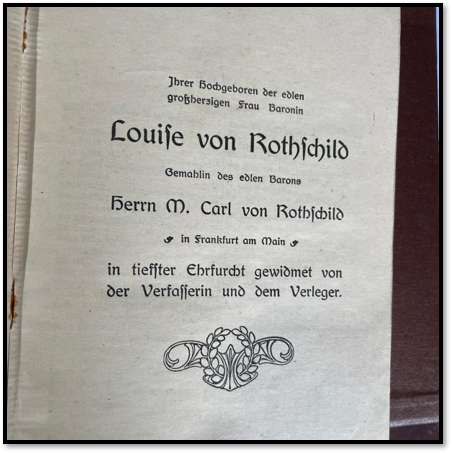
On the first page, before the beginning of the book, appeared a printed dedication:

“To Baroness Louise Mayer Carl von Rothschild, with deep appreciation from the author and the publisher.”

Why her, of all people? Who was Louise Rothschild? And what was the connection between her and Fanny Neuda? For years, this book stood at the center of my research, until the dedication to Louise Rothschild opened a new chapter.

Hours of Devotio with the dedication

Who Was Louise Rothschild?

Louise de Rothschild (1820-1894) was the youngest daughter of Nathan Mayer Rothschild, founder of the Rothschild banking family in London. In 1842, she married her cousin,
Mayer Carl von Rothschild, from the Frankfurt branch of the family, and moved to live
in Frankfurt. She was a mother to seven daughters. But her activities did not end there.

Materials found in the Rothschild Archive in London reveal that Louise was a devout woman, engaged in writing on religious topics, and established and funded numerous charitable
and educational institutions in Frankfurt.

Did a network of other women stand behind the prayer books written by women, supporting, encouraging, funding, promoting, or granting them status? Alongside the women who wrote the books, were there other women operating who did not hold an official title,
but had an immense influence on Jewish life?

An inquiry I made to the Rothschild Archive in London yielded an important answer.
The archive holds two different copies of Hours of Devotion, printed in 1879 by two different publishers. In both copies, the same printed dedication to Louise Rothschild appears.

This finding changes the way the book is read. This is not a private handwritten dedication on a single copy. This is a dedication printed as part of the book itself.
Meaning, the author and the publishers sought to publicly link Louise Rothschild’s name
to the book.

As the research progresses, it becomes apparent that the story might not be just about two women. It may tell the story of a much broader network. One woman wrote.
Another woman provided inspiration, status, or support.

  • Did Louise Rothschild know Fanny Neuda?

  • Who initiated the dedication?

  • Was she involved in distributing the book?

  • Did she support the funding of editions?

  • Is there a correspondence between them?

  • Have documents been preserved in other archives?

At this stage, we do not have answers.
Precisely for this reason, the research is only in its infancy.

Why Is This Important?

For years, Jewish history was written primarily through rabbis, leaders, institutions,
and bankers. But behind many of the books, initiatives, and enterprises stood women
as well.

Perhaps this is the true story hiding behind the small dedication to Louise Rothschild. Not just the story of one woman. Rather, the story of a European female network
of creativity, influence, philanthropy, and Jewish continuity, which is still waiting
to be told.

About Us | Women's Prayer Project

The “Women’s Prayer” project began two decades ago as a book that documented and collected Jewish women’s prayers throughout history. The book, which became a bestseller, revealed an entire world that had almost disappeared from our sight – a breathing and vibrant Jewish-feminine space that reflects a Jewish life story that was almost never told through conventional historical tools.

Today, marking 20 years since the book’s publication, we are proud to expand the project to a new format of prayer cards, combining the ancient prayers together with images from a stunning Judaica collection (courtesy of the William Gross Collection, photography: Arnon Barmucha).

The cards are intended for daily use, personal contemplation, family ceremonies and community activities – they invite us to return and reconnect with the rich feminine tradition that passed from mother to daughter throughout the generations.

Our Books

Women’s Prayer Cards (Tefilat Nashim) We use cookies to ensure the website functions properly and improve user experience. You can choose which types of cookies to enable.
Cookie Selection


Join us for women's prayer

A connection to the Jewish story through women’s voices
Join to receive sources, prayers, rituals and stories from the Jewish female tradition.