Share:

Facebook
LinkedIn
WhatsApp

Rosh Chodesh: The women’s holiday

An ancient feminine tradition of prayer, renewal and hope.

Rosh Chodesh is much more than a date on the calendar. It is a day of a new beginning,
of renewal, of looking toward the time ahead. In Jewish tradition it has always been connected to women, to the waning and renewing moon, to feminine wisdom, to the secret of cyclicality,
to hope and to starting anew.
In the communities of Israel Rosh Chodesh was kept as a special day for women: a day of prayer, rest, personal requests, lighting candles, visiting the graves
of matriarchs and righteous women, a shared meal, and abstaining from household chores.

Why Rosh Chodesh is considered a women’s holiday

Rosh Chodesh is the first day of the birth of the moon, and from it the days of the month
and the festivals of Israel are counted. Already in the Torah it is mentioned as a special day, and eventually it also received a unique place in the world of women.
The Sages connected women and Rosh Chodesh through the story of the Sin of the Golden Calf. When the men asked for the gold jewelry for the purpose of making the calf,
the women did not rush to comply. Therefore, they were given Rosh Chodesh as a special day, a holiday of their own and the right to be renewed like the moon.
Additional traditions connect Rosh Chodesh to the making of the Tabernacle as well:
the women did not participate in the Sin of the Golden Calf, but they did contribute with
a generous heart to the building of the Tabernacle. The Tabernacle was erected on the first
of Nisan, the head of all months, and from this the connection between Rosh Chodesh
and the spiritual status of women was strengthened. Rabbi Yosef Chaim of Baghdad,
the “Ben Ish Hai”, explains that on Rosh Chodesh women have a special status,
and even emphasized that in this matter the women are more primary than the men,
because the new months were taken from the men following the Sin of the Golden Calf
and given to the women. Fascinating evidence is found in the Book of Kings,
in the story of the “great woman” of Shunem.
After years of barrenness, the prophet Elisha blessed her, and indeed a son was born to her.
The boy grew up, but one day, while being in the field with his father, he fainted and died.
The “great woman” of Shunem called to her husband in the field to harness the donkey,
so that she could visit the man of God. And behold, the man wonders “And he said, Why are you going to him today? It is neither new moon nor sabbath! And she said, Peace!”
The Shunammite’s custom was to go to the prophet on new months and sabbaths.
It is clear that she was not alone in this. It is possible that women would gather together,
without their families in the courtyard of the “man of God”. We have no sources regarding their custom during the visit. Perhaps they studied with him. And perhaps they sat near
him and sang and studied among themselves and marked the occasion as the presence of the prophet rested upon them.
The moon, women and the secret of renewal

It is possible that more than any other occasion, Rosh Chodesh expresses the connection between time and the inner life. The moon wanes, disappears, and reappears.
Human life as well, and especially the lives of women, often move between waning
and renewal, between brokenness and hope, between disappearance and reappearance. Because of this, Rosh Chodesh is kept as a day of inner listening, of pausing,
of prayer and of hope. Not only as a halachic day, but also as a time of the heart.

Women’s customs on Rosh Chodesh

In many communities, women kept unique customs for Rosh Chodesh, and passed them down from mother to daughter.
Despite the distance between the communities, one can identify a moving similarity between the customs that were preserved across the Jewish world.
One of the distinct expressions of this is the abstention from work.
Already in the Jerusalem Talmud, the custom of women not to do work on Rosh Chodesh is mentioned, and it is said of it that it is a “good and proper custom”. In some of the communities women abstained mainly from crafts such as spinning, sewing and embroidery, and in other places they also ceased from household chores or from work for a livelihood.
My late grandmother Chana Mashiach who was born in Afghanistan and immigrated
to Jerusalem in 1920 would not do household chores,
wore festive clothes, lit a candle and went to the synagogue together with her friends.
In Ashkenazi communities, the eve of Rosh Chodesh was sometimes called
“Yom Kippur Katan”, while in Sephardic and Eastern communities the day was called “Mishmeret Rosh Chodesh” or “Mishmeret HaChodesh”. Many women turned the day into a space of forgiveness, prayer and intimate dialogue with the Creator of the world.

Women in the communities of Israel

One of the moving things about Rosh Chodesh is the way in which women
in such distant communities kept a similar core of custom, even though each community
gave it its own special color.
In Kurdistan, women used to light candles in honor of Rosh Chodesh and bake
a special thin bread.
In Babylon, women used to light two candles on the night of Rosh Chodesh,
to distinguish the day from a weekday.
In Tunisia, women used to visit the cemeteries on the eve of Rosh Chodesh,
and on the night of Rosh Chodesh the lady of the house would light the candle rack and prepare a festive meal for the following day In Libya, women used to prostrate themselves on the graves of their relatives, light a candle and hold a special meal, and while the candle was lit they abstained from certain chores.
In Morocco, many women used to light a candle when the stars came out, and sometimes also in the morning, and dedicate the time to prayer and requests.
In Ashkenaz, women used to light candles, wear festive clothes, and sometimes
also abstain fro certain chores.
In the Land of Israel, Rosh Chodesh was known as a particularly festive day, in which women used to visit the Western Wall and Rachel’s Tomb, hold meals and dedicate the day to prayer. Despite the differences between the communities, one common element returns in all of them:
Rosh Chodesh is a time for women of pausing, holiness, prayer and renewal.

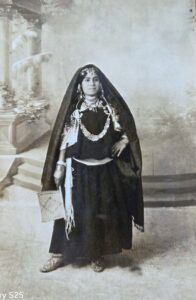
Masouda Mazouz-Kimchi was born in the city of Gabes in Tunisia in 1900. Grandmother of Chana Ledwin.

Rosh Chodesh and women’s prayer

Throughout the generations, women created a spiritual language of their own
around Rosh Chodesh.
One of the fascinating figures in this context is Sarah Rivkah Rachel Leah Horowitz,
who wrote a special piyyut and techinah for the blessing of the new month. Her writing indicates a rich Torah world and a desire to grant women a language of prayer fitting
the status of the day. In doing so she expresses a profound truth: even when women
did not stand at the center of the official religious space,
they created from within it and from within their lives a living, feminine spiritual language.
In Ashkenazi communities many women have the custom to recite on Rosh Chodesh
“Shir Hama’alot”, Psalms 126, a chapter of longing, return and hope:
A Song of Ascents.
When the Lord brought back the returning exiles of Zion, we were like dreamers.
Then our mouth was filled with laughter, and our tongue with joyous song.
Then they said among the nations, The Lord has done great things for these.
The Lord has done great things for us, we were joyful….
Among the Jews of the East, women make a point of reciting “Barchi Nafshi”, Psalms 104,
which concludes the morning prayer of Rosh Chodesh and includes the moon and all of creation:
Bless the Lord, O my soul.
O Lord my God, You are very great, You are clothed in glory and majesty.
Covering Yourself with light as with a garment, stretching out the heavens like a curtain.
He made the moon for seasons, the sun knows its setting.
You send forth Your spirit, they are created, and You renew the face of the earth…
One can see in the choice of these chapters a profound expression of the feminine consciousness of Rosh Chodesh:
renewal, creation, hope, return and redemption.

Rosh Chodesh returns to women today as well

In recent years Rosh Chodesh returns and takes a renewed place in the lives of women in Israel and around the world.

Women meet on new months to study, sing, pray, recite Psalms, hold Amen meals, bless one another and create together a feminine space of spirit, memory and strengthening. There are those who gather around feminine texts,

there are those who recite Psalms, there are those who study words of Torah, and there are those who hold a festive meal whose heart is blessing, thanksgiving and answering “Amen”.

Thus Rosh Chodesh returns to being not only an occasion on the calendar, but also a living feminine space of renewal.

Many women adopt from the customs of the past and add of their own:

• To light a candle in honor of Rosh Chodesh

• To wear festive clothing or a special piece of jewelry as a symbol of renewal

• To abstain from certain chores, especially spinning, sewing and embroidery

• To recite chapters of Psalms, especially “Shir Hama’alot” or “Barchi Nafshi”

• To visit the graves of matriarchs and righteous women and to pray

• To hold a small family meal in honor of the day

• To make personal requests for the new month

Rosh Chodesh reminds us that renewal is not only a matter of time, but also a way of life. Women knew how to keep the secret of this day for generations, in the home, in prayer, in custom and in memory. And today as well, with the birth of the moon, the possibility to start anew returns and opens Rosh Chodesh teaches us that even when the moon wanes it is destined to return and shine, and also out of brokenness and restriction it is possible to start anew.

Source of the entry

The entry is based on the chapter “Rosh Chodesh – The Women’s Holiday” from the book Women’s Customs, Yedioth Books, Aliza Lavie, 2008.

About Us | Women's Prayer Project

The “Women’s Prayer” project began two decades ago as a book that documented and collected Jewish women’s prayers throughout history. The book, which became a bestseller, revealed an entire world that had almost disappeared from our sight – a breathing and vibrant Jewish-feminine space that reflects a Jewish life story that was almost never told through conventional historical tools.

Today, marking 20 years since the book’s publication, we are proud to expand the project to a new format of prayer cards, combining the ancient prayers together with images from a stunning Judaica collection (courtesy of the William Gross Collection, photography: Arnon Barmucha).

The cards are intended for daily use, personal contemplation, family ceremonies and community activities – they invite us to return and reconnect with the rich feminine tradition that passed from mother to daughter throughout the generations.

Our Books

Women’s Prayer Cards (Tefilat Nashim) We use cookies to ensure the website functions properly and improve user experience. You can choose which types of cookies to enable.
Cookie Selection


Join us for women's prayer

A connection to the Jewish story through women’s voices
Join to receive sources, prayers, rituals and stories from the Jewish female tradition.