Share:

Facebook
LinkedIn
WhatsApp

The Girl Who Wrote: Luna Amron’s Esther Scroll

Rome, 1767. A fourteen year old Jewish girl completes with her own hands a Scroll of Esther and a sheet of blessings for the reading of the Megillah, signing her name, her age, and her lineage. More than 250 years later, her handwriting allows us to encounter not only a rare scroll, but also a Jewish girl creating, studying, and writing within community life.

“In the fourteenth year of her birth and her life”

Luna Amron was only fourteen years old when she completed in Rome, on the 10th of Adar I 5527, February 9, 1767, the writing of the Scroll of Esther and the sheet of blessings accompanying it. The exhibition at the Israel Museum presents for the first time the scroll
and the sheet of blessings that she signed.

At the margins of the work, Luna left a kind of colophon, a scribe’s signature, in which she wrote: “With the help of God, awesome in deeds, the writing of these blessings along with the Megillah was completed… all in script by the hand of the Lord who granted wisdom to the modest and pleasant young woman, Mistress Luna the pure […] in the fourteenth year of her birth and her life…”

The very mention of her age is extraordinary. It is rare for manuscript scribes to note their age, and rarer still for the writer to be a woman.


Photo courtesy of the Israel Museum, Jerusalem, Zohar Shemesh
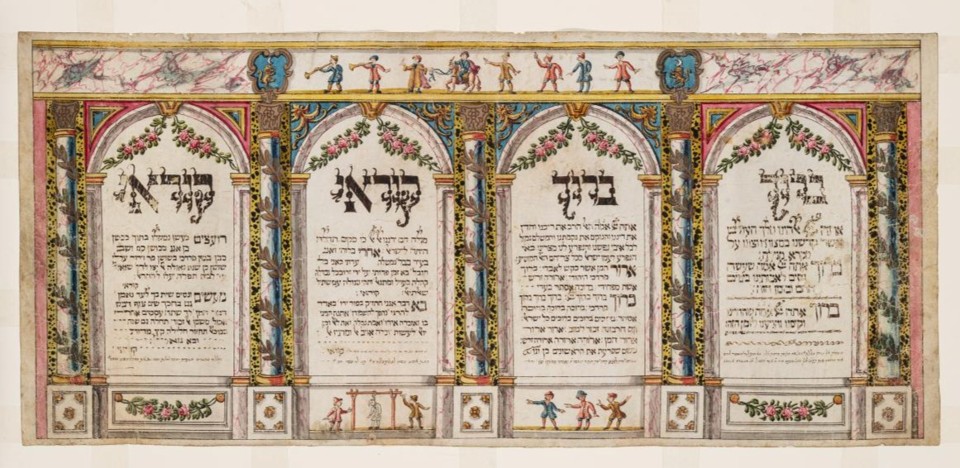
Sheet of blessings for the reading of the Megillah copied by Luna Amron. The Israel Museum Collection: Purchased through the generosity of the Jack, Joseph and Morton Mandel Foundation to the American Friends of the Israel Museum, in honor of Daisy Raccah-Djivre
Photo © The Israel Museum, Jerusalem, by Zohar Shemesh

Who Was Luna Amron?

The colophon makes it possible to identify Luna as the daughter of Yehuda Amron, a member of a prominent Jewish family in Rome. The detailed inscription allows us to place her within the world of the Jewish community in the Roman Ghetto, a community that, although living within
a confined space, maintained extensive ties with the surrounding society and operated within
a rich and diverse cultural environment. The scroll itself also bears signs of the family’s status, including the family emblems. Nine years after writing the scroll, Luna married Angelo Yaakov Di Segni, who was also a member of a prominent Italian Jewish family. Her original ketubah (marriage contract) has been preserved to this day. Yet just before we continue on to her life as a married woman, it is worth pausing for a moment at the age of fourteen. A Jewish girl sits in 18th century Rome and writes a Scroll of Esther. Not merely reading. Not merely listening. Writing.

Women Who Wrote Scrolls

Luna’s artifact joins a very small group of Jewish manuscripts known to be the work of women. The exhibition at the Israel Museum also presents additional rare manuscripts written by women from Italy, shedding new light through them on the place of women in religious life
and in the Hebrew scribal tradition. The very existence of these scrolls also intersects with an ancient halakhic discussion: Is a Scroll of Esther written by a woman kosher for the ritual reading? While a Torah scroll, tefillin, and mezuzot were placed within a different halakhic framework, regarding the Scroll of Esther there was a dispute among halakhic authorities. Rabbeinu Tam, Maimonides (Rambam), and other early authorities (Rishonim) did not address this issue explicitly. However, later authorities relied on the rulings of the early authorities regarding the parallel between a Torah scroll and a Scroll of Esther in terms of stringency,
and from this concluded that Rabbeinu Tam would disqualify such writing, whereas Maimonides would permit it. This discussion makes Luna’s manuscript even more fascinating: it is not merely testimony to personal talent, but opens a window onto broader questions regarding women’s education, Hebrew literacy, participation in religious life, and the possibilities available to them across different communities.

Why Is Luna Important to Us Today?

Because she shifts the picture slightly. When we tell Jewish history solely through the materials that became part of the canon, it is easy to think that women simply were not there. And then comes a single scroll, a single signature of a fourteen year old girl, and tells us: We were here. We wrote. We studied. We created. This is precisely one of the roles of the Women’s Prayer (Tfilat Nashim) project: not to add women to the past retroactively, but to return to the sources, the manuscripts, the objects, and the memories, and discover the voices that were already there. Luna Amron is not merely an “extraordinary girl from the 18th century.” She is part of a broader story that we are still learning to piece together. And when a fourteen year old girl today encounters the handwriting of a fourteen year old girl from Rome of 1767, a connection is forged that cannot be created through a historical date alone. Suddenly the past takes on a face. And heritage transforms from something that must be “preserved” into something from which one can draw strength.

Credit and Source

Scroll of Esther and sheet of blessings for the reading of the Megillah signed by Luna Amron Rome, 1767. Collection of the Israel Museum, Jerusalem. Purchased through the generosity of the Jack, Joseph and Morton Mandel Foundation to the American Friends of the Israel Museum, in honor of Daisy Raccah-Djivre. Photo © The Israel Museum, Jerusalem, by Zohar Shemesh. This entry was written following the research and exhibition “The Girl Who Wrote: Luna Amron’s Esther Scroll,” The Israel Museum, Jerusalem, Wing for Jewish Art and Life, curated by Anna Nitsa-Kaplan.

About Us | Women's Prayer Project

The “Women’s Prayer” project began two decades ago as a book that documented and collected Jewish women’s prayers throughout history. The book, which became a bestseller, revealed an entire world that had almost disappeared from our sight – a breathing and vibrant Jewish-feminine space that reflects a Jewish life story that was almost never told through conventional historical tools.

Today, marking 20 years since the book’s publication, we are proud to expand the project to a new format of prayer cards, combining the ancient prayers together with images from a stunning Judaica collection (courtesy of the William Gross Collection, photography: Arnon Barmucha).

The cards are intended for daily use, personal contemplation, family ceremonies and community activities – they invite us to return and reconnect with the rich feminine tradition that passed from mother to daughter throughout the generations.

Our Books

Women’s Prayer Cards (Tefilat Nashim) We use cookies to ensure the website functions properly and improve user experience. You can choose which types of cookies to enable.
Cookie Selection


Join us for women's prayer

A connection to the Jewish story through women’s voices
Join to receive sources, prayers, rituals and stories from the Jewish female tradition.