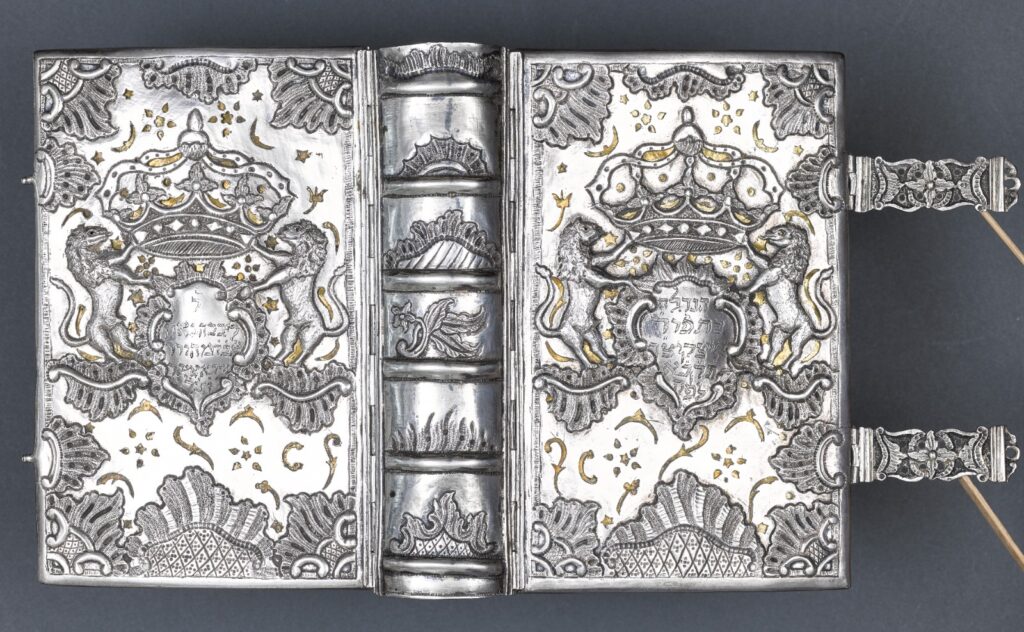
A Prayer for a Daughter to Find a Worthy Groom –
The Kabbalist Rabbi Salman Mutzafi
“May it be Your will, Lord our God and God of our fathers, that You be filled with mercy for me and provide for me a handsome spouse who fears God and is a Torah scholar,
possessed of intellect and good traits, successful and blessed in his studies and his endeavors,
for through this we will be able to build a home in Israel as You have commanded us in Your holy Torah: ‘And you, be fruitful and multiply.’ And may the young man spoken of for me be worthy, possessing the fear of God, good traits, good fortune, and be suitable for me.
In Your abundant mercy, grant me grace and incline my heart and the hearts of my parents to finalize the matter, and may it be good for us in this world and in the world to come. God full of mercy, merciful, gracious, guardian, supporter, rescuer, upright, redeemer.”
Rabbi Salman Mutzafi (1900-1975) was born in Baghdad, immigrated to Israel in 1935,
and was among the students of the Kabbalist Rabbi Yehuda Fatiyah. He established a yeshiva near Rachel’s Tomb which operated until the establishment of the State.
Rabbi Salman Mutzafi, who was also known as a Kabbalist, resided in Jerusalem and delved deeply into the wisdom of Kabbalah and intentions (kavanot). His prayers for the peace of the people of Israel were renowned. He made sure to visit the graves of the righteous and even wrote by hand the order of prayers and studies to be recited beside each righteous person’s grave.
A Prayer for Finding a Match – Rabbi Nachman
“Loving God, so many are lacking true love; so many cannot find their match.
Have mercy on them. Source of love, allow every lonely and isolated soul, to experience the wholeness that flows from finding a match.”
Rabbi Nachman of Breslov was born in 1772 in the city of Medzhybizh in Ukraine.
He was the great-grandson of the Baal Shem Tov. Before he turned twenty,
he already led a group of Hasidim in an original and unique path, which did not gain sympathy among other Hasidic leaders, who suspected him of Sabbateanism. The opposition to his work, as well as his young age, his leadership methods, and his sharp expressions, roused the Hasidic leaders against him. In 1798, Rabbi Nachman left his family, traveled to the Land of Israel, and stayed there for an entire winter, mainly in Safed and Tiberias.
Those days in the land were the days of Napoleon’s war with the Turks. His stay there greatly influenced Rabbi Nachman. He later recounted: “All the vitality I possess comes only from my time in the Land of Israel.” Four years later, in 1802, he arrived in the city of Breslov, where he formed the core of his teachings and established his circle of students – the Breslov Hasidim.
Rabbi Nachman loved to seclude himself with his Creator and pour out his thoughts in prayers he would speak from his heart, prayers he composed in moments of spiritual fervor. Rabbi Nachman knew much sorrow in his life. He lost his wife and several of his children, who died of illnesses. When he felt his death approaching, due to the tuberculosis that afflicted him – he moved to the city of Uman, where he passed away in the month of Tishrei 5571 (1810) – and where he is also buried. Rabbi Nachman of Breslov himself wrote only two books: one of them was burned by his command, and the second remains hidden among his followers. The well-known books containing his teachings were written by his student –
Rabbi Nathan Sternhartz. This touching prayer is taken from the book The Gentle Weapon:
Prayers for Everyday and Not-So-Everyday Moments (1999), based on the eternal teachings of Rabbi Nachman of Breslov, and formulated by Moshe Mykoff and S. C. Mizrahi.
A Prayer for a Woman for Complete Healing or a Spouse – The Ben Ish Chai
“I, (so-and-so daughter of so-and-so, hereafter: plonit bat plonit) ask and request of the soul
of my master the righteous one… [Ezekiel the Prophet] peace be upon him, that you pray for me before the Lord our God and God of our fathers, God of Abraham, God of Isaac,
and God of Jacob, that He may spare, have compassion, and have mercy upon me, I, plonit bat plonit, to give me strength and health in my entire body, in my limbs and my sinews,
and that He may bring healing and cure to all my illnesses and all my pains… And furthermore, I, plonit bat plonit, ask and request of the soul of my master the righteous one, etc., that you pray, etc., that He may spare, have compassion, and have mercy upon me, I, plonit bat plonit, and provide for me my spouse, a good and righteous man, and I will marry my spouse in joy and gladness, wealth and honor. And may the Holy God in His abundant mercy bestow upon me and my husband a good livelihood from His broad, full, rich, and open hand, and may we merit to bear male children and rejoice in them and in their wedding canopy, and may we see children to our children in joy and gladness, wealth and honor. Amen, so may it be Your will.”
This prayer was composed by the “Ben Ish Chai” (Rabbi Yosef Chaim of Baghdad).
The source of the prayer is in the book Ben Ish Chai. The custom is to recite this prayer at the tomb of the Prophet Ezekiel and at the graves of other righteous individuals.
The Single Woman’s Prayer – Rabbi Yoel Bin-Nun
“Please, Lord God, hear the cry of the single women searching for their destined partner, and provide them with their match, and may they merit to build their homes
in joy and in purity, and to raise their offspring in love, in health, and in the blessing
of the Lord, (It is Shabbat, a time to refrain from crying out, but salvation is soon to come), and let us say: Amen.”
Credit: All prayers, excerpts, and sources presented on this page are from the book Women’s Prayer by Dr. Aliza Lavie, published by Yedioth Books.