Share:

Facebook
LinkedIn
WhatsApp

Buba Bodana:
Between an open book
and a life of prayer

One single email, from an unidentified address in Vancouver, opened up an entire world
of Jewish womanhood.
It happened when I received a letter from the researcher Prof. Hillel Goelman,
following his inquiry for information about women’s prayers to integrate into his community.
The discourse that developed between us about text, prayer, and life, led him back
to an old family album of his father’s.
There, between the pages, a single photo was found: his great-grandmother,
who was called “Buba Bodana.”
She is sitting at a table, and beside her is an open book.
A woman. A book. A home. But as one looks closer at the photo, it ceases to be a private moment and becomes a gateway.
Buba Bodana likely lived in Europe in the late 19th or early 20th century, but her exact details
are not known. It is precisely this ambiguity that allows a glimpse beyond one story,
into an entire space of Jewish women’s lives.
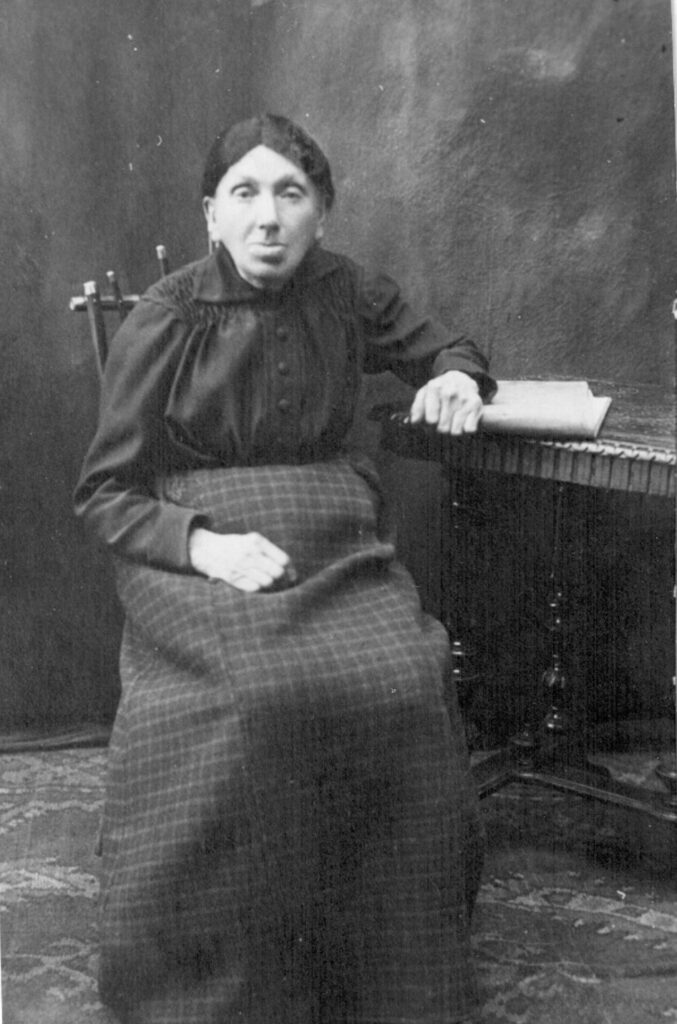
Buba Bodana, the great-grandmother of Prof. Hillel Goelman

Which book lay before her?
Did she read from Tze’enah u-Re’enah? From Meneket Rivkah? Or perhaps from a personal prayer book, an everyday prayer, words spoken between kitchen and room,
between children and the world? We have no answer.
But it is precisely the lack of knowledge that opens another possibility for listening.

Hillel himself writes that through creative imagination he tries to return to her world:
to her spiritual practice, to the love of family, to the love of Torah that was woven into her life. Imagination here does not fill a void of missing knowledge, but creates a bridge.

It allows us to draw closer to lives that were not written, yet existed with intensity.
Buba Bodana is not a canonical figure.

History was not written about her, her writings were not studied in academia.
And yet, she embodies an entire world of Jewish female knowledge, knowledge woven
at home, in the movement between text and life, between reading and action,
between tradition and existence.

The encounter with Buba Bodana is not merely an archival discovery. It is a living movement
of memory. One letter returns a great-grandson to a photo, and one photo returns
us to a broader question: what is preserved, and what is forgotten.
In this photo, there is also silent testimony to a Jewish world where women read, interpreted, and created for themselves a spiritual language within the space of life.

Buba Bodana is a link in the chain but also a link that awakens anew
when someone asks about her.

The Women’s Prayer community was born out of the understanding
that this knowledge exists. It was not lost, but rather pushed to the margins.

And it is possible, and necessary, to restore it.
And Buba Bodana, like many women before and after her, invites you to ask:
What did the women in our families read?
How did they pray?
Which words accompanied their lives?

By Prof. Hillel Goelman, Scholar of Human Development and Jewish Education

About Us | Women's Prayer Project

The “Women’s Prayer” project began two decades ago as a book that documented and collected Jewish women’s prayers throughout history. The book, which became a bestseller, revealed an entire world that had almost disappeared from our sight – a breathing and vibrant Jewish-feminine space that reflects a Jewish life story that was almost never told through conventional historical tools.

Today, marking 20 years since the book’s publication, we are proud to expand the project to a new format of prayer cards, combining the ancient prayers together with images from a stunning Judaica collection (courtesy of the William Gross Collection, photography: Arnon Barmucha).

The cards are intended for daily use, personal contemplation, family ceremonies and community activities – they invite us to return and reconnect with the rich feminine tradition that passed from mother to daughter throughout the generations.

Our Books

Women’s Prayer Cards (Tefilat Nashim) We use cookies to ensure the website functions properly and improve user experience. You can choose which types of cookies to enable.
Cookie Selection


Join us for women's prayer

A connection to the Jewish story through women’s voices
Join to receive sources, prayers, rituals and stories from the Jewish female tradition.