Share:

Facebook
LinkedIn
WhatsApp

A Family Journey Following the Women’s Prayer Traditions of Izmir

 Shir Arbiv’s research takes her on a family journey in search of the life and legacy of her great-great-grandmother, Sharina (Sharina Pardo-Sidi), who lived in Izmir at the end of the nineteenth and the beginning
of the twentieth century.
Sharina, an educated and thoughtful woman, was the last in her family’s line of women who carried daily prayer on their lips. “In her hands remained an ancient Book of Psalms and a copy of Shevet Musar printed in Izmir in 1888,” Shir writes, “books that were passed down as heirlooms and became symbols of a broken chain of feminine spirituality in my family.”

“She was the last woman in our family line who prayed every day.
Always holding a small Book of Psalms, always dressed in black, always praying.”

Interview with her granddaughter, Laila Huli

Sharina lived within a vibrant Sephardi Jewish community. Her home was a center of distinct women’s customs and rituals: marking Rosh Chodesh as a women’s holiday, keeping the Four Species after Sukkot and placing them in a beautiful vase, amulets against the evil eye, and a red birth-cloth to protect mothers and infants from Lilith.
The house was also a hub of Hebrew and liturgical culture. Sharina taught the girls of the family to recite Shema and Psalms, and every Shabbat she would read aloud from the ancient Psalms book that is preserved to this day.

.
“She would read Psalms in Ladino and Hebrew, covering her eyes with the palm of her hand as she prayed.”
With the rise of modern Turkey and Atatürk’s sweeping reforms, the Jewish community of Izmir underwent dramatic change. Language, dress, and daily life became increasingly secular and Western. The daughters who grew up after Sharina gradually lost their fluency in the language of prayer, and religious life receded to the margins of identity.

“I grew up singing songs about Atatürk,” her granddaughter Laila recalls,
“and only on my first visit to Israel did I realize I wanted my children to have heroes of their own.”

Through her studies in the Women’s Prayer course, Shir rediscovered the spiritual roots of her family through its objects: the amulet, the red birth-cloth, and the old Book of Psalms.
In the meeting point between memory and faith, a new dialogue was born:

“I understood that prayer is a privilege, a bond across generations.
I speak the language of prayer, and I myself am the fulfillment of a prayer.”

Shir Arbiv’s work weaves academic research together with spiritual repair.
It restores to the center a circle of learned, devout women of Izmir women whose identity and faith were inseparable from daily life, textiles, protective amulets, and the breath itself.

Did your family also preserve prayer items or amulets passed down from one generation to the next?
We invite you to share a memory or a photo and add your family’s voice to the map of women’s prayer.

Based on the research of Shir Arbiv, “Women’s Prayer,” Bar-Ilan University, taught by Dr. Aliza Lavie, 2024

Between Past and Present

Today this tradition is returning, becoming part of learning circles and all-night study sessions across Israel in study halls, seminaries, synagogues, and community gatherings.
The testimony of Tamar Abutbul, from an Iraqi family in Pardes Katz, echoes the practices described by the Ben Ish Hai and brings them into the present.

Her story connects women’s learning on Hoshanah Rabbah night with the rhythm of everyday life, with family memory, and with communal circles.
In doing so, she restores to Jewish culture the voices of women who studied, prayed, and sought to touch the inner light of the final night of Sukkot.

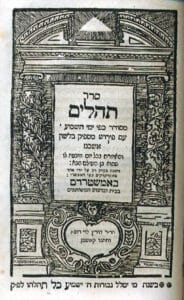
Psalms arrangement in Ladino – Judeo-Spanish, the language of the heart of the Jews of Spain after the expulsion from Spain and Portugal. Printed in the city of Amsterdam in the 17th or 18th century. Many women carried the book in their bags, prayed, read from it by the bedside of the sick, during childbirth, in times of danger, and on days of joy. The image is courtesy of the Gross family collection.

About Us | Women's Prayer Project

The “Women’s Prayer” project began two decades ago as a book that documented and collected Jewish women’s prayers throughout history. The book, which became a bestseller, revealed an entire world that had almost disappeared from our sight – a breathing and vibrant Jewish-feminine space that reflects a Jewish life story that was almost never told through conventional historical tools.

Today, marking 20 years since the book’s publication, we are proud to expand the project to a new format of prayer cards, combining the ancient prayers together with images from a stunning Judaica collection (courtesy of the William Gross Collection, photography: Arnon Barmucha).

The cards are intended for daily use, personal contemplation, family ceremonies and community activities – they invite us to return and reconnect with the rich feminine tradition that passed from mother to daughter throughout the generations.

Our Books

Women’s Prayer Cards (Tefilat Nashim) We use cookies to ensure the website functions properly and improve user experience. You can choose which types of cookies to enable.
Cookie Selection


Join us for women's prayer

A connection to the Jewish story through women’s voices
Join to receive sources, prayers, rituals and stories from the Jewish female tradition.