Font "Noa" - Handwriting That Became Living Letters
On this website, we use a special font created from the handwriting of Lookout Noa z”l, who fell on October 7th at the Nahal Oz outpost at age 20.
Noa was full of joy and energy, loved music and dance, and dreamed of traveling the world and making it a better place. Her friends remember her as a source of inspiration who always performed her duties with professionalism and pride. She received her commander’s beret with the dedication: “The light in your heart will overcome any obstacle on the way to your goal.”
The font was created as part of the “Living Letters” project – a moving initiative that transforms the handwriting of fallen soldiers into digital fonts, so their words continue to live and make an impact.
Just as Noa dreamed – even after she’s gone, the light in her heart continues to overcome every obstacle and do good in the world.
The Jewish kitchen has never been merely a space of cooking and food preparation, but rather a “mikdash meat” [minor sanctuary] for women throughout the generations.
Among the aromas of the dishes, the kneading of the dough, and the commandment of separating challah, an ancient and wondrous secret of quiet female prayer was woven.
This is the intimate and warm space where tears, hopes, and simple requests blended with love into the pots,
and where daily action turned into heart-work full of intention that was passed down in tradition from mother to daughter.
In this entry, we have gathered for you things and stories that women wrote and shared with us, about special customs that existed in their family – small traditions, personal prayers, and moments of sanctity all connected to food, the kitchen, and the home.
Since the page is still under construction and growing right now, we would love to hear from you too! You are invited to share with us customs, memories, and prayers that are passed down in your family, and to take part in creating this touching female mosaic.
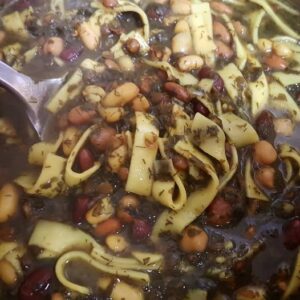
The Persian Pregnancy Stew “Ash-e Reshteh”
In my family, of Persian origin, there are special foods for all kinds of celebrations.
One of them is a Persian stew called “Ash-e Reshteh.”
It is a sort of tart Persian soup with legumes, greens, and Persian lemon,
in which flat noodles are incorporated.
This stew is prepared as a charm for an easy birth for pregnant women,
and it was also prepared for me during my various pregnancies.
A bowl of it always warms my heart and stomach,
and above all reminds me that behind us is a tradition of generations of women,
dating back to Tehran of previous centuries, and that this food goes with us in the family
from generation to generation.
Courtesy of: Ruth Ofek, attorney and blogger at Happy Kitchen
The Persian stew “Ash-e Reshteh”
The Opening of the Knife: Halalem
At midday on Tisha B’Av, the atmosphere in the home would shift.
In the family tradition of Tunisian Jewry, the moment midday arrived,
the announcement was made: “Tehallat al-skina” – the knife is opened.
The proclamation marked the transition from the heavy hours of mourning to the beginning
of comfort and the anticipation of redemption.
In an instant, a commotion would fill the house: the women stood up, began cleaning,
tidying the rooms, and starting preparations and cooking for the end of the fast.
It was an almost festive moment. The home, which had remained in an atmosphere
of destruction for hours, began to awaken anew. Washing the floor, arranging items,
and preparing food were not merely housework, but a tangible expression of the belief
that mourning does not last forever and that comfort follows destruction.
One of the dishes prepared for breaking the fast was Halalem: a rich, thick soup containing small, hand-rolled pasta flakes.
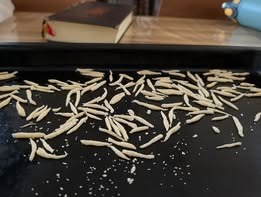
The flakes of the Halalem
The flakes were made from a simple dough of flour, water, and oil, sometimes with semolina added. The dough was rolled into long, thin strips, cut into small pieces, and rolled between the fingers until tiny, elongated flakes were formed.
Afterward, they were left to dry until the soup was cooked. The prolonged labor filled the hours of the fast, but it also held a deeper meaning: the hands created food for the new life that would begin after the fast.
Within a day commemorating destruction, the women were already preparing the home and family for comfort.
In the family of Yehudit Mazala Yona of blessed memory, who passed away two years ago,
the custom was lovingly preserved. Every year, the family prepared Halalem,
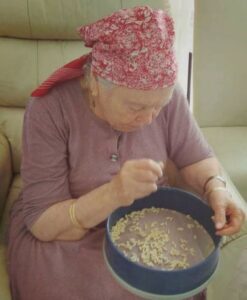
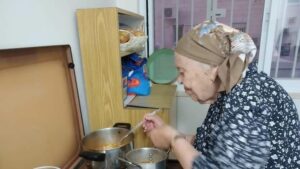
and her granddaughter, Bracha Siman-Tov, photographed the preparations and sent the pictures to her grandmother and family members. The custom continued to live on even after her passing. Family members continue to prepare the flakes and the soup in her memory,
and one of them even prepared Halalem with his friends during the fighting in Gaza – flake after flake, far from home, yet within an unbroken family chain.
In memory of Yehudit Mazala bat Portuna Yona, may her memory be blessed.
In memory of Yehudit Mazala bat Portuna Yona, may her memory be blessed.
This is how tradition is passed down: not always in books or documents, but in the movement of hands, the scent rising from the pot, a phrase spoken at midday, and a dish that a woman teaches her family to make.
Family Halalem Recipe
Fry an onion until golden brown and add garlic, a generous tablespoon of harissa, cumin, turmeric, paprika, salt, and pepper. Add tomato paste and gradually a small amount of water until
a uniform, relatively thin sauce is formed.
Add pumpkin, carrot, zucchini, celery, pre-soaked chickpeas, and lentils. Cook over low heat, checking during cooking to ensure there is enough water. About ten minutes before serving, add the hand-prepared Halalem flakes.
Documentation and Photography: Bracha Siman-Tov, granddaughter of Yehudit Mazala Yona z”l.
Family Story: Erez Luzon, who wrote about his aunt and the custom preserved in the family.
The “Women’s Prayer” project began two decades ago as a book that documented and collected Jewish women’s prayers throughout history. The book, which became a bestseller, revealed an entire world that had almost disappeared from our sight – a breathing and vibrant Jewish-feminine space that reflects a Jewish life story that was almost never told through conventional historical tools.
Today, marking 20 years since the book’s publication, we are proud to expand the project to a new format of prayer cards, combining the ancient prayers together with images from a stunning Judaica collection (courtesy of the William Gross Collection, photography: Arnon Barmucha).
The cards are intended for daily use, personal contemplation, family ceremonies and community activities – they invite us to return and reconnect with the rich feminine tradition that passed from mother to daughter throughout the generations.
Women’s Prayer Cards (Tefilat Nashim)
We use cookies to ensure the website functions properly and improve user experience. You can choose which types of cookies to enable.
Join us for women's prayer
A connection to the Jewish story through women’s voices Join to receive sources, prayers, rituals and stories from the Jewish female tradition.

 Add pumpkin, carrot, zucchini, celery, pre-soaked chickpeas, and lentils. Cook over low heat, checking during cooking to ensure there is enough water. About ten minutes before serving, add the hand-prepared Halalem flakes.