“Morning, and You shall hear my voice”

Word of Inspiration

Time and Place

Prayer Content

Rare Judaica Item
Courtesy of the Gross Family

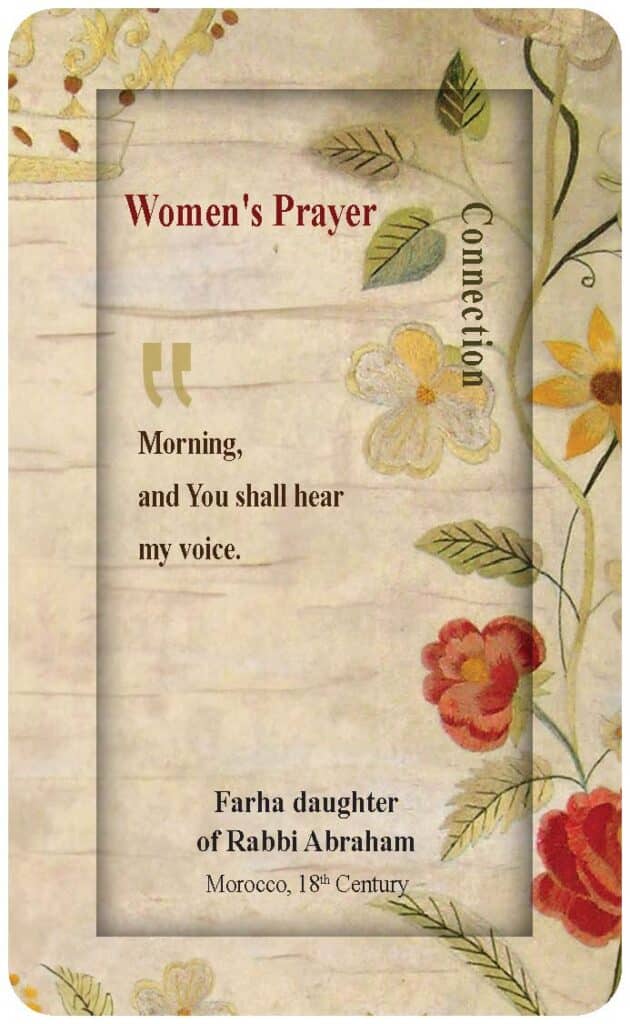
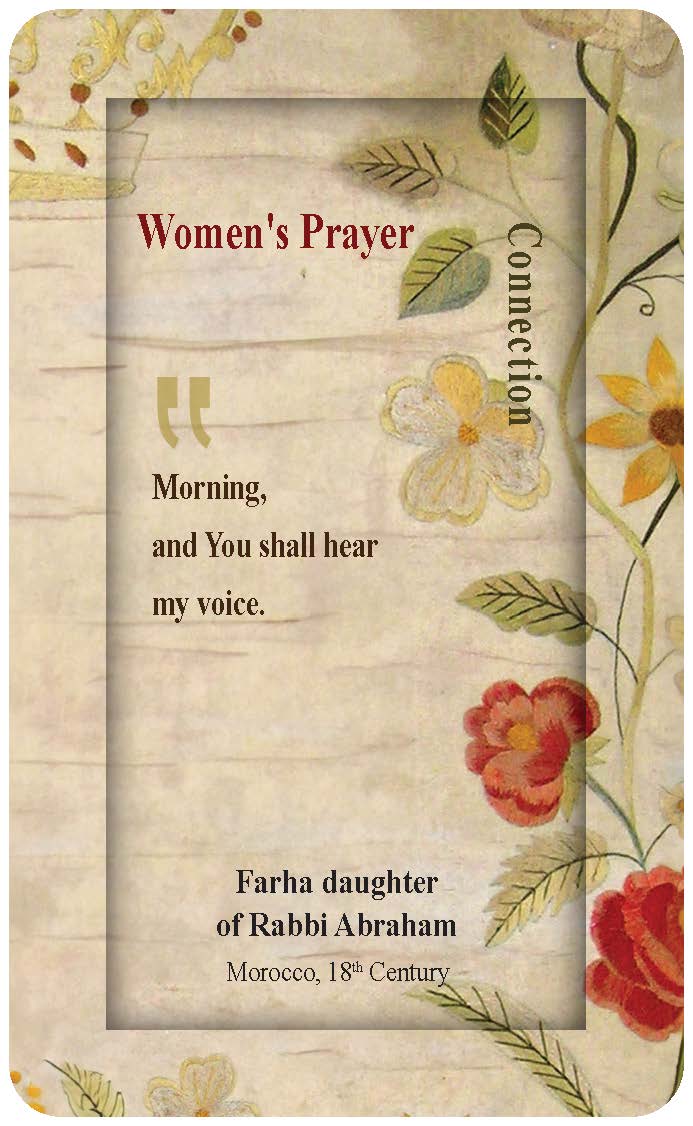
“Morning, and You shall hear my voice”

Morocco, 18th century 
Word of Inspiration: Connection

In 18th-century Morocco lived and wrote Freha bat Rabbi Avraham, also known by her pen name “Bat Yosef” (daughter of Yoshef). A Hebrew poetess and learned woman, she was considered a spiritual figure and a scholar in Halakha. Her generation called her “the Rabbanit”, not only because of her lineage, but due to her faith, wisdom, greatness in Torah and her ability to speak both to the heavens and to the hearts.

Freha wrote poetry and prayer in Hebrew, leaving behind personal and communal liturgical poems that serve as living testimony to women who studied, created and wrote in the holy language. Some of her writings have been lost, only a few have survived, passed down through prayer, memory and research.

The phrase written on the card, Morning, and You shall hear my voice, is taken from the liturgical poem of request to face us with mercy, composed by Freha.

The liturgical poem was intended for weekday Shacharit prayer (morning prayer).

Weekday requests addressed two main themes: a plea for redemption and a plea to walk in the way of Torah and mitzvot.

The ancient liturgical poem face us with mercy includes both the collective and individual prayers: a request for hastened redemption, for the return to Zion and the rebuilding of the Temple and also for forgiveness,
grace and personal closeness.
About the Image:

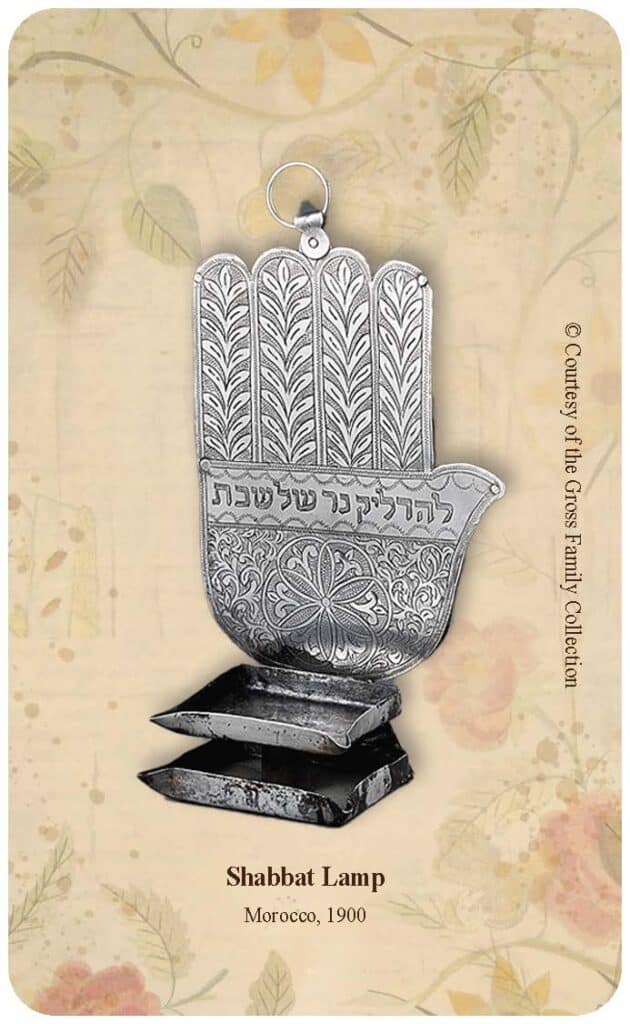
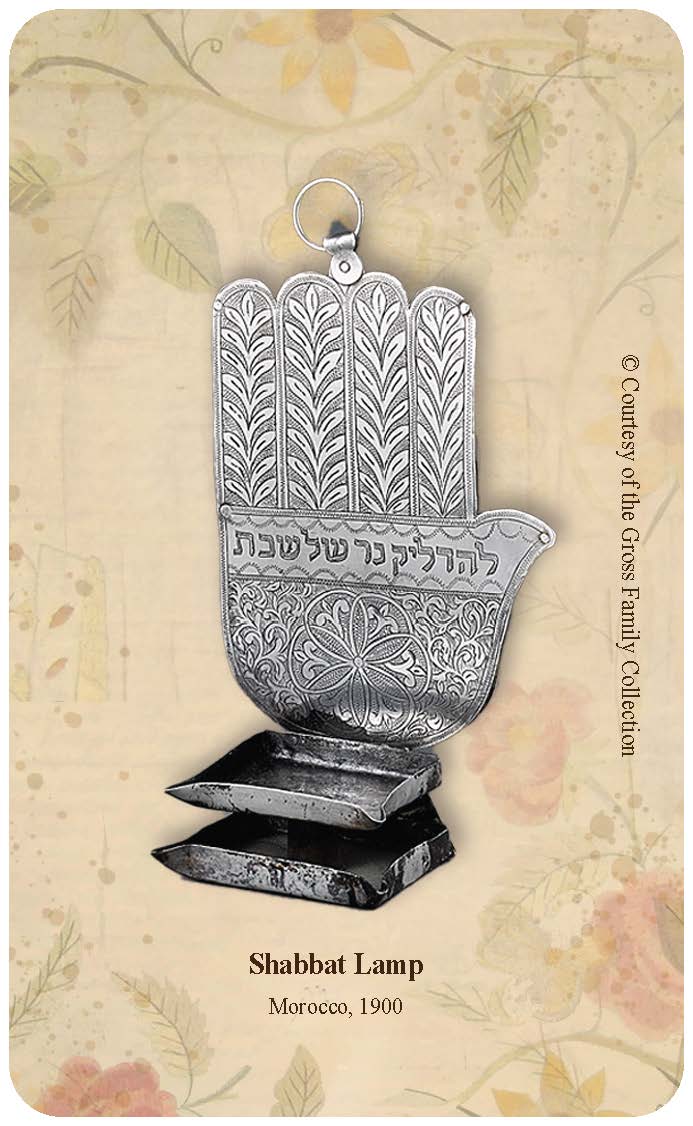
Shabbat Lamp, Morocco, 1900

The Shabbat lamp is intended for lighting a candle on Friday before Shabbat begins. This rare lamp is shaped like a Hamsa, a powerful symbol in Eastern communities representing protection, abundance and blessing. At its center, the blessing “to light the Shabbat candle” is engraved.

This lamp was created in early 20th-century Morocco, but it embodies a much deeper tradition. It tells the story of Jewish women whose homes hosted the Shechinah (the presence of G-d) not only on Shabbat, but throughout the entire week. Lighting the candle is a moment of elevation out of labor, worries and burdens, into inner stillness, connection and hope. It is an invitation, in every single generation, to take a moment for yourself, light a candle and make a blessing.

An Invitation to Reflect:

What is the morning in which your voice longs to be heard?
Is there a prayer in your heart that has never been spoken aloud?
This card invites you to begin the day not only with action, but with intention. Choose a quiet moment in the morning, before the hustle and bustle begins and offer a request, a thanks, or a word of connection.

Inspiration for Using the Card:

The power of Women’s Prayer Cards in exploring identity, belonging and the search for meaning.

Personal Process

This is a card of dawn, for moments in which a voice rises from within, even after a night of exhaustion or a season of searching.
Question for personal work: When I say hear my voice, what do I mean?
Exercise: Write your own morning prayer. Not from the head, from the gut.

Another exercise: Write five sentences that begin with “I would like to…” Look at them and notice what has already been heard and what has not yet.

Discussion Circle

The phrase “Morning, and You shall hear my voice” invites us to begin a session of learning,
writing or emotional work.
Suggestion for the circle: Each participant shares a request that once arose from them with the break of dawn, in the moment of waking, while everything was still quiet.


Another suggestion: Freha was a religious woman, a creator, a poet and a leader in her 18th-century Moroccan community. Despite her status and influence, her name was nearly forgotten from historical memory, like so many other women who led and took action but were never fully acknowledged.

This card opens up a conversation about women’s voices that were spoken but never recorded, about quiet presence and the importance of recognition.

Questions for the circle

Why is it important to expand our knowledge about women who acted within
tradition rather than at its margins?
Where do I ask for my voice to be heard?
When did I feel that my voice wasn’t heard and how would I like to reclaim it?

Emotional and Therapeutic Work

The card invites us to reflect on those moments when a silent prayer rises within us, not yet spoken aloud. It touches on the quiet before movement, the request that does not yet have
words and the longing to be truly heard.

Guided Visualization: Imagine a quiet morning, just before waking. What is the first sound you wish to hear? What would you like to say to yourself, or to someone else?

A personal object as a representation of a voice or a request: Choose an object in the room that symbolizes “the unheard voice” and create a conversation around it.
You may also draw that voice or give it a color or movement.

To Deepen

Additional information about Freha bat Rabbi Avraham and her liturgical poems can be found in the A Jewish Woman’s Prayer Book, in the chapters about the women of the Maghreb and Hebrew women writers.
Further reading can also be found in Women’s Customs and in articles on women’s poetry in Morocco.

This card is especially suited for therapeutic work in situations of:
Experiencing invisibility or silencing.
Strengthening a sense of inner worth and voice.
Processing moments of subtle rupture, before collapse, before beginning.
Supporting processes of writing, parting, asking and loss.


“Light rises in the morning
On a distant lake (do you remember)
Yes, I remember
And I shall not cease, and I shall not be silent”

Naomi Shemer

Between Words and the Wisdom of the Heart

A contemporary faith echoes an ancient liturgical poem 

“In the path of faith I chose, and in the path of faith I returned”

These words were written by Agam Berger, a soldier
kidnapped from the Nahal Oz base by the terrorist organization Hamas and held captive in Gaza for 482 days.
She wrote these words on a whiteboard in the helicopter
ride following her release
and was photographed with them as a message to the entire nation.
These words became a message of hope,
resilience and inner commitment.
Between Freha and Agam, between the Shabbat candle and the
light that has been returned,
this card carries the journey of two women who choose to believe.

Click me

Women’s Prayer Cards (Tefilat Nashim) We use cookies to ensure the website functions properly and improve user experience. You can choose which types of cookies to enable.
Cookie Selection


Join us for women's prayer

A connection to the Jewish story through women’s voices
Join to receive sources, prayers, rituals and stories from the Jewish female tradition.