Share:

Facebook
LinkedIn
WhatsApp

Torah Study for Women on the Eve of Hoshana Rabbah

On the night of Hoshana Rabbah, it is customary to engage in Torah study all night,
following a special order called Tikkun Leil Hoshana Rabbah. This is the night that concludes the festival of Sukkot, and in Jewish tradition, it is considered a time of grace and the sealing
of judgment. For generations, this nighttime study was primarily associated with men,
but in both our sacred sources and family memories, a profound feminine dimension
is revealed, of women who held their own study sessions sometimes in the home
and sometimes in the portico beside the sukkah.

The “Ben Ish Hai” (Rabbi Yosef Chaim of Baghdad) already testified to this in 19th century Baghdad: “But on the night of Hoshana Rabbah, they stay awake and study Mishneh Torah and Psalms, and the prayers of those who make a covenant, for we sit and study inside
the sukkah in the courtyard, and they sit above in the portico facing the sukkah,
and study alongside us in their own space.”

Similar testimonies are heard in recent generations as well, teaching us that this tradition
has not vanished, but continues to thrive within feminine spaces.
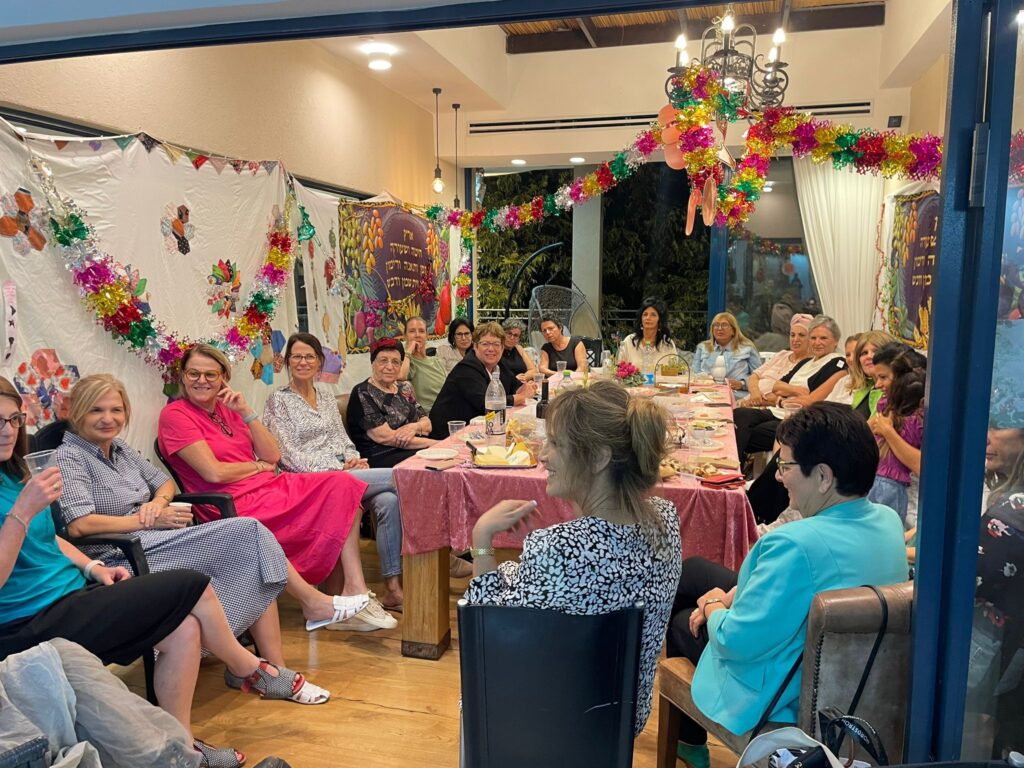
A Testimony from the Abutbul Family of Pardes Katz, Roots in Iraq

In her work for the “Women’s Prayer” course at Bar Ilan University, Tamar Abutbul interviewed the women of her family: her grandmother Dalia, her mother Yael, and her aunt Tamar Mualem. She discovered a rich feminine custom connected to the night of Hoshana Rabbah:

“In Iraq, on the eve of Hoshana Rabbah during Sukkot, the nights when people stayed awake
to study Torah were called ‘Khatima’. The women would gather, take a large tray, fill it with sand, and light many candles in it in memory of the departed members of the family.
Amidst the talking and prayers, they would prepare ‘Sha’ariya’, a dough made of flour
and water rolled into thin noodles and left to dry throughout the night.
In the morning, they would eat them with oil, salt, and garlic.”
(From the testimony of Dalia Shemesh, Tamar Abutbul’s grandmother)

The women prayed, talked, and studied together throughout the entire night,
alongside the men who studied Zohar and Torah. The night became a multilayered feminine gathering of memory, grace, and vibrant communal action. They bridged prayer and study, body and soul, the memorialization of the departed and the preparation of simple foods
that expressed compassion and connection.

Tamar concludes in her work: “I understood how important these customs and gatherings
are for the women in my family. They create a sense of belonging, identity, and connection between the generations. Even those who are not religious feel that these customs connect them to the tradition and to their grandmothers.”

Between Past and Present

Today, this custom is returning, becoming part of study nights across the country in study halls, women’s seminaries, synagogues, and communities. Tamar Abutbul’s testimony from her Iraqi family in Pardes Katz echoes the tradition described by the Ben Ish Hai, adding to it a profound layer of living, tangible memory. It bridges the feminine study on the night of Hoshana Rabbah between the sacred and the everyday, between family tradition and communal circles.
In doing so, it restores to the heart of Jewish culture the voices of women who studied, prayed, and sought to touch the light of the final night of the Sukkot festival.

About Us | Women's Prayer Project

The “Women’s Prayer” project began two decades ago as a book that documented and collected Jewish women’s prayers throughout history. The book, which became a bestseller, revealed an entire world that had almost disappeared from our sight – a breathing and vibrant Jewish-feminine space that reflects a Jewish life story that was almost never told through conventional historical tools.

Today, marking 20 years since the book’s publication, we are proud to expand the project to a new format of prayer cards, combining the ancient prayers together with images from a stunning Judaica collection (courtesy of the William Gross Collection, photography: Arnon Barmucha).

The cards are intended for daily use, personal contemplation, family ceremonies and community activities – they invite us to return and reconnect with the rich feminine tradition that passed from mother to daughter throughout the generations.

Our Books

Women’s Prayer Cards (Tefilat Nashim) We use cookies to ensure the website functions properly and improve user experience. You can choose which types of cookies to enable.
Cookie Selection


Join us for women's prayer

A connection to the Jewish story through women’s voices
Join to receive sources, prayers, rituals and stories from the Jewish female tradition.