Font "Noa" - Handwriting That Became Living Letters
On this website, we use a special font created from the handwriting of Lookout Noa z”l, who fell on October 7th at the Nahal Oz outpost at age 20.
Noa was full of joy and energy, loved music and dance, and dreamed of traveling the world and making it a better place. Her friends remember her as a source of inspiration who always performed her duties with professionalism and pride. She received her commander’s beret with the dedication: “The light in your heart will overcome any obstacle on the way to your goal.”
The font was created as part of the “Living Letters” project – a moving initiative that transforms the handwriting of fallen soldiers into digital fonts, so their words continue to live and make an impact.
Just as Noa dreamed – even after she’s gone, the light in her heart continues to overcome every obstacle and do good in the world.
Rosh Hashanah | Yael Gordon: When a Letter Becomes a Prayer
Must a prayer be written in a prayer book?
On the eve of Rosh Hashanah, while far from Degania, Yael Gordon wrote a greeting letter to the members of the kibbutz. At first glance, this is a personal letter. Upon closer reading, a prayer is revealed within it: a prayer for responsibility, for a better society, for the light of the soul, and for the betterment of humanity. Dr. Einat Ramon invites us to read Yael Gordon’s letter as a rare moment of female prayer in a renewing Eretz Yisrael- a prayer that is not spoken in the synagogue, but written within the midst of life.
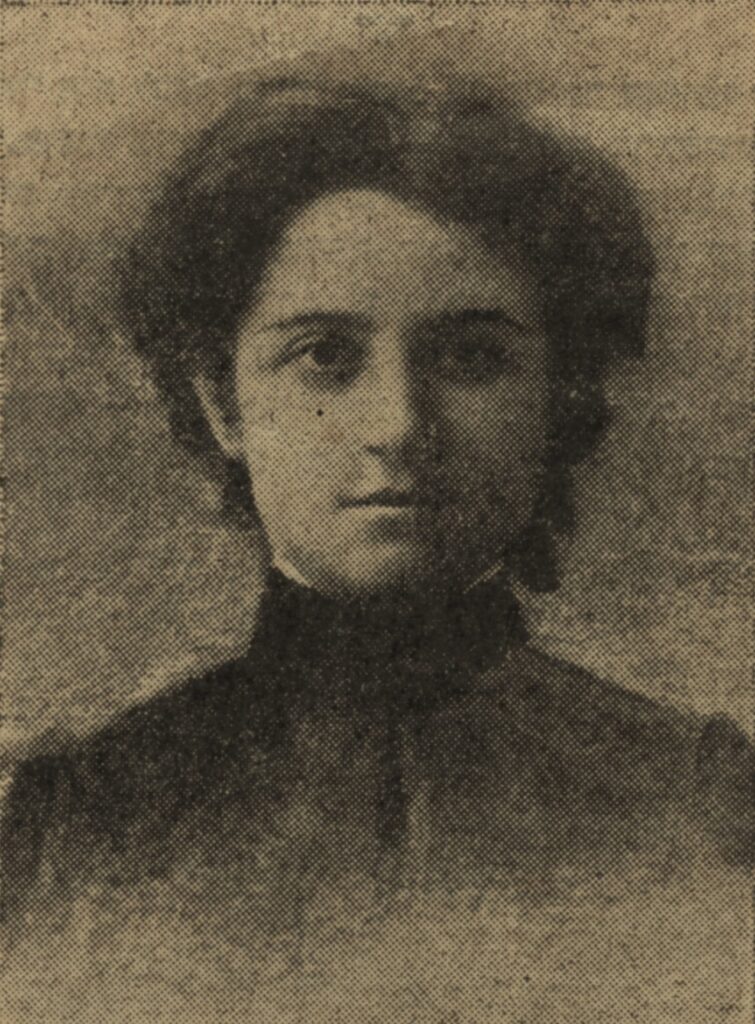
Yael Gordon in her youth. Courtesy of the Degania A Archive.
Yael Gordon – A Voice of Spirit Within the Practical Life
Yael Gordon (1879-1958), the daughter of Aharon David Gordon, was an educator, a pioneer, and a member of Degania A. She taught Hebrew, worked in agriculture, and viewed labor, education, and community life as parts of a single way of life.
But to truly encounter Yael, one must read her letters.
There, she does not appear merely as a figure from the Second Aliyah, but as a living, thinking, hurting, observing, and questioning woman. In her letters to her father, she writes about work and bodily weakness, about longing, and about the need to find a quiet corner where she can be with her thoughts and feelings.
Following a difficult episode of dismissal from Jerusalem, she wrote to her father:
“I will not lie to you by saying that it is easy for me. But I am not devoid of the strength to master my spirit.” This is not a prayer in the conventional sense, but it embodies an inner standing before life and a plea for the strength to continue.
Yael did not separate the life of the spirit from practical life. Labor, teaching, membership in the group, treatment of the other, observance of the Sabbath, concern for the Hebrew language, and grappling with pain – all were part of that same life’s work. Her letters repeatedly feature the movement that Dr. Einat Ramon calls “revealing the light of the soul” –
an attempt to uncover the light within a person even when reality is harsh, weary, or fractured.
The “I” of the Woman-Human
At the Working Women’s Conference in Merhavia in 1914, Yael spoke of the desire of young Hebrew women in the land not only to fulfill a national role, but also to find themselves.
She called this “the “I” of the woman-human.” For her, pioneering was not merely tilling the soil or belonging to a movement. It was also a search for a place where a Jewish woman could
be a complete person: working, creating, studying, feeling, believing, and seeking the root
of her soul.
Even when living within a pioneering world, part of which had distanced itself from the religious framework, her language remained rooted in the sources of Israel. She wove in biblical verses, rabbinic sayings, and Jewish expressions not as literary decoration, but as the natural language of thought and soul. When she writes about relationships within Degania and quotes the Mishnaic teaching: “Be as meticulous in a minor commandment as in a major one,”
she translates these words into the life of the group. Meticulousness in a commandment becomes meticulousness in one’s attitude toward a fellow member, in attentiveness to the individual, and in the way a human society is built.
Here, a particularly important Jewish-women’s voice is revealed: a voice that does not speak
of holiness in detachment from life, but within life itself amid responsibility, forgiveness,
care for the other, and a constant effort to mend one’s perspective.
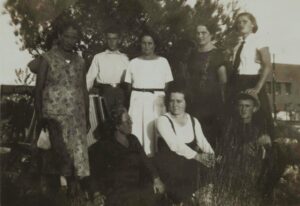
Yael Gordon standing in the center in a white dress. Courtesy of the Degania A Archive.
Writing, Soul, and Repair in a Renewed Eretz Yisrael
Yael Gordon wrote a greeting letter to the members of the kibbutz on the eve of Rosh Hashanah, while she was far from Degania. She sought to send in words what she could not give that evening with a handshake: closeness, responsibility, hope, and a blessing for a good year. The letter was written as a holiday blessing, but between its lines, the voice of a prayer
is also heard. Not an ordered prayer from a prayer book, and not a supplication in thetraditional structure, but a prayer born from within community life: a request for a good spirit, mutual understanding, personal responsibility, and the mending of relations between human beings.
Yael opens with a simple and warm appeal: “Please accept my warm and profound blessing.” Yet the blessing does not remain merely a festive wish. It transforms into a call for communal introspection. Yael asks her friends to remember that “none of us are angels,”
and to strive with all their might to instill among themselves a good spirit filled with grace.
She suggests turning the gaze inward, first fixing the “I” rather than the “thou.”
This is not merely a holiday blessing. It is an invitation to inner work, to the understanding
that society is built from the personal responsibility of each and every individual.
A Prayer for Humanity and the World
Yael’s Rosh Hashanah blessing begins with the close-at-hand: with the friends, the holiday,
and the longing for a handshake. But from there, it expands outward to the entire world.
She observes human progress and the wonders of technology, expressing pain that they are sometimes used for destruction rather than building. And then comes a request that holds the true essence of prayer: “And may we merit in the new year approaching us to see an awakening of the human spirit.”
This is no longer just a blessing for the members of Degania. It is a prayer for humanity.
For society. For the world. For the possibility that a new light will shine upon the nations, and that human beings will walk in a better and more just path.
A Prayer Written Within Life
Yael Gordon opens a wide gate for us to understand women’s prayer. Not only prayer written
as a prayer book or a supplication, but a prayer found within a letter, a diary, a holiday greeting,
an internal conversation, a request for forgiveness, concern for the other, and the insistence on guarding the light of the soul. Reading her letters teaches that not every prayer is written
as a siddur or a petition. Sometimes, precisely a personal letter, a holiday greeting,
or a conversation with a father becomes the place where the soul stands before itself,
before the other, and before the future it seeks to build. Yael Gordon did not leave behind a prayer book.
She left behind a path of writing imbued with prayer.
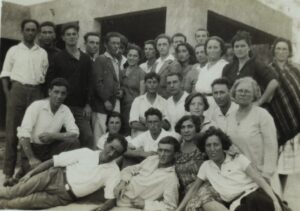
Yael Gordon with the members of Degania. Courtesy of the Degania A Archive.
From Yael Gordon’s Rosh Hashanah greeting letter to the members of Degania
From the personal blessing, a prayer grows for humankind and for all of humanity.
“Please accept my warm and profound blessing…”
“In the festive moments of holiday blessings, let us strive with all our might…
to always remember that none of us are angels…”
“All of human society is invited and obligated… to elevate the ‘I’ first and foremost, before all else, and not the ‘thou’.”
“Human progress in technology… [leads] not to the building of a new and better world… but rather to finding ways… to destroy human culture.”
“And may we merit in the new year approaching us to see an awakening of the human spirit… to remove the nightmare of the threats of war from upon us… and may a new light shine upon the nations.”
Credits and Further Reading
This entry is based on Dr. Einat Ramon’s article, “Revealing the Light of the Soul in the Letters and Writings of Yael Gordon,” Masechet, Issue 20, 2025 (5786).
The quotations from Yael Gordon’s letters and writings are presented following Dr. Ramon’s article and from the Yael Gordon file in the Degania A Archive.
The “Women’s Prayer” project began two decades ago as a book that documented and collected Jewish women’s prayers throughout history. The book, which became a bestseller, revealed an entire world that had almost disappeared from our sight – a breathing and vibrant Jewish-feminine space that reflects a Jewish life story that was almost never told through conventional historical tools.
Today, marking 20 years since the book’s publication, we are proud to expand the project to a new format of prayer cards, combining the ancient prayers together with images from a stunning Judaica collection (courtesy of the William Gross Collection, photography: Arnon Barmucha).
The cards are intended for daily use, personal contemplation, family ceremonies and community activities – they invite us to return and reconnect with the rich feminine tradition that passed from mother to daughter throughout the generations.
Women’s Prayer Cards (Tefilat Nashim)
We use cookies to ensure the website functions properly and improve user experience. You can choose which types of cookies to enable.
Join us for women's prayer
A connection to the Jewish story through women’s voices Join to receive sources, prayers, rituals and stories from the Jewish female tradition.