Font "Noa" - Handwriting That Became Living Letters
On this website, we use a special font created from the handwriting of Lookout Noa z”l, who fell on October 7th at the Nahal Oz outpost at age 20.
Noa was full of joy and energy, loved music and dance, and dreamed of traveling the world and making it a better place. Her friends remember her as a source of inspiration who always performed her duties with professionalism and pride. She received her commander’s beret with the dedication: “The light in your heart will overcome any obstacle on the way to your goal.”
The font was created as part of the “Living Letters” project – a moving initiative that transforms the handwriting of fallen soldiers into digital fonts, so their words continue to live and make an impact.
Just as Noa dreamed – even after she’s gone, the light in her heart continues to overcome every obstacle and do good in the world.
Home » Blog » Articles » The manuscript from Bordelo and the prayer of the female crypto-Jews in Portugal
Share:
Facebook
LinkedIn
WhatsApp
The manuscript from Bordelo and the prayer of the female crypto-Jews in Portugal
Secrets under the floor: The rare manuscript of Anusim in Portugal
There are traditions that have been preserved in magnificent synagogues, and there are those that survived in whispers, in hidden rooms, and under wooden floors.
The recently discovered Rebordelo manuscript is a chilling testament to the remarkable world of the Crypto-Jews in Portugal.
Through a small prayer book hidden for generations, we are exposed to the devotion of women who kept the Jewish spark alive under impossible conditions.
Prayer Book to the Supreme God
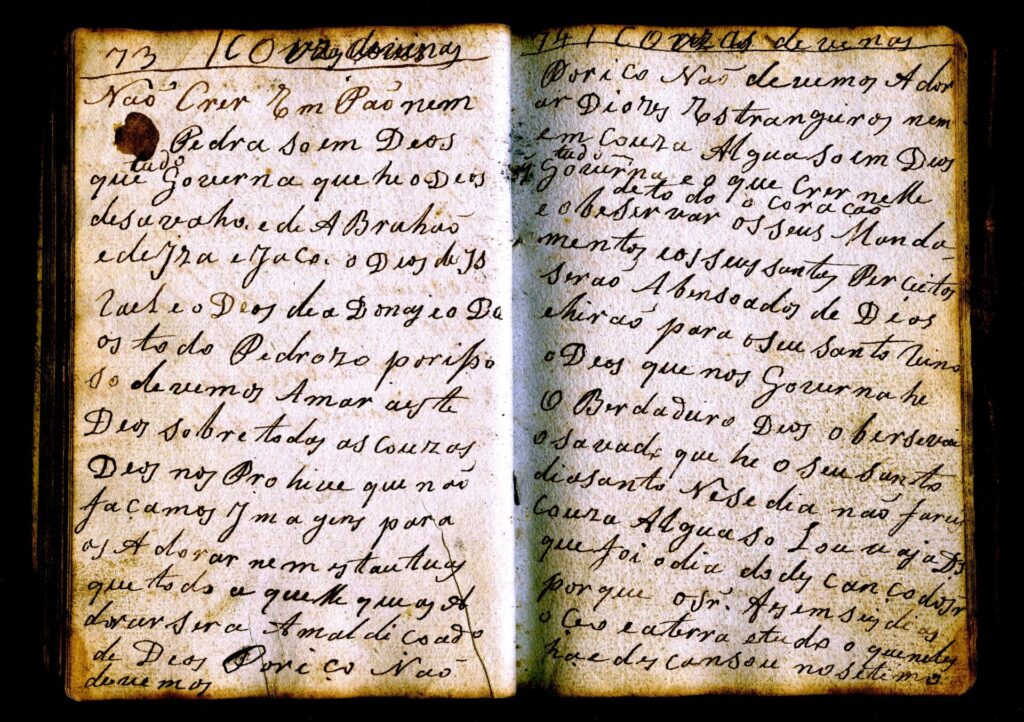
The manuscript, originating from the village of Rebordelo in the Trás-os-Montes region, bears the title: Libro de Oraçoins ao Alticimo Deos todo Pedrozo (A Prayer Book to the Supreme, Almighty God).
It is a small manuscript, ninety-nine pages on lined blue paper, bound in brown leather. Researchers estimate that it was copied or written in the first half of the 19th century.
Its contents reveal the extent to which the lives of the Crypto-Jews were not merely a distant memory of a Judaism subjected to forced conversion, but rather a living system of prayers, moral instructions, verses, customs, and family documentation.
The book is divided into three main parts: In the first part, prayers and moral recommendations appear. In the second part, called Couzas Devinas (“Divine Things”), principles of faith, commandments, and biblical passages are presented. In the third part, family events were recorded, including births, weddings, deaths, and additional prayers.
Thus, the manuscript becomes not only a prayer book but also a family archive. It holds within it what was forbidden to be kept openly: identity, memory, religious language, and belonging.
A digital scan of the Marbordello manuscript, prepared by Prof. Avi Gross. The photograph was taken in 2008 by Dr. Yoel Rappel, who was also the first to send the manuscript by fax during that same visit.
The Judaism Preserved in the Home
The story of the manuscript is connected to the figure of Dona Teresa Pais Dias, a descendant of the Crypto-Jews in the region.
Ruth Ariel, who researched and documented the community, met her in 2002.
Dona Teresa was the daughter-in-law of Alfredo Gaspar, who is mentioned as the owner of the manuscript in 1928, and as someone who was apparently the last person to live openly as a Jew in Rebordelo.
Alfredo Gaspar was connected to the Resgate movement, “The Rescue” or “The Return”, led by Captain Barros Basto in Porto in the early 20th century, in an attempt to bring the descendants of the Crypto-Jews back to an open Jewish life.
According to the testimony provided, Gaspar even celebrated a Bar Mitzvah within the framework of this movement, and was active in the connections forged between Porto, Bragança, and Chaves.
Before his death, Gaspar gave the manuscript to his daughter-in-law, Dona Teresa, and asked her to protect it and never part with it.
She indeed kept it for decades. She almost never showed it to anyone. The book was hidden in her home, wrapped in cloth, inside a box, under the floorboards. To take it out, she had to lift several floor tiles.
This image, a prayer book resting under the floor, is almost a symbol of the entire world of the Crypto-Jewish women:
A Judaism that does not disappear, but rather moves to the domestic, feminine, and secret space. Not in the public sphere, but in the room. Not aloud, but in a whisper. Not always in standard writing, but in a mixed, living, liminal language that preserved memory.
Prayer in a Border Language
The Rebordelo manuscript is written in a language that is not simple to decipher. It combines Portuguese, Galician-Portuguese, border languages, theological concepts, excerpts from Psalms, prayers, and family documentation. Prof. Avi Gross, who received exceptional access to the manuscript in 2017 or 2018 through the Trás-os-Montes Center for Jewish Studies, prepared high-quality scans of it and dedicated years to translation, comparison, and research.
The work of deciphering is not merely linguistic. It is also historical, familial, and spiritual. The prayers are compared to testimonies from Inquisition trials, local family names, traditions passed down orally, and recurring patterns of Crypto-Jewish life in the region.
It is precisely the errors, the transitions between languages, and the non-uniform versions that attest to a religious life that did not pass through organized institutions. This is not the Judaism of an open Beit Midrash (study hall) or a recognized community. This is a Judaism of a kitchen, a storehouse, a cellar, a wooden box, an embroidered cloth, and a candle that is hastily covered when a stranger arrives.
Women as Guardians of Prayer
When Judaism was pushed out of the public sphere, the home became a small sanctuary. There, candles were lit. There, words were kept safe. There, prayers were passed down from mother to daughter, from grandmother to granddaughter, sometimes without a full understanding of their origin, but out of a profound knowledge that they must be preserved.
In testimonies from Tras os Montes, objects and customs specifically associated with women appear time and again: embroidered prayer cloths used in ceremonies and holidays, sometimes in different colors according to various life events; oil lamps called “Lamps of the Lord” used for lighting Shabbat candles in secret; prayers recited by heart; and sacred objects concealed in hidden cabinets.
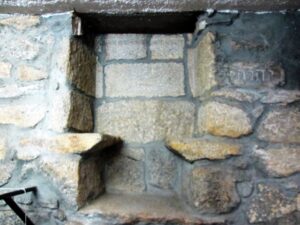
In the home of Major Afonso from Chaves, a central figure in the local network of remembrance, objects of this kind were documented: a secret cabinet acting as a hidden ark disguised as a window or an ordinary cupboard, Shabbat lamps that could be swiftly covered in case of danger, and additional manuscripts of Anusim (crypto Jewish) prayers, safeguarded by the family and revealed only on rare occasions.
These details weave a broader narrative: the Anusim were not merely frightened individuals. They formed a network. These were families who knew one another, intermarried, protected each other, traded together, and transmitted an encrypted Jewish memory among themselves.
At the heart of this network, women played a decisive role: they guarded the Shabbat within the walls of the home, the prayer within the body, and the tradition within the quiet acts of daily life.
The Secret Ark in the Home of Major Afonso in Chaves
Candles That Can Be Covered
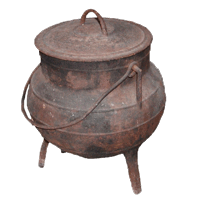
One of the most moving details in the testimonies is the description of the oil lamps used to light Shabbat candles in secret. Outwardly, they could appear to be ordinary household items, resembling kettles or iron pots. On the eve of Shabbat, they would be filled with olive oil and lit. If a stranger entered, the vessel could be swiftly covered, concealing the flame.
It is a small custom that carries an entire world.
The flame exists, but it must not be seen. Shabbat enters, but it must not announce itself. The woman lights, but she must be prepared to conceal.
This candle is a prayer. It is also fear. It is also courage. It is a testament that a Jewish tradition can survive even when it bears no public name, even when there is no rabbi, no recognized community, no open synagogue, and no printed book.
“Lamps of the Lord”, the hidden Shabbat lamps.
The Manuscript as a Living Link
The Rebordelo manuscript does not stand alone. It is part of a broad tapestry of hidden Jewish memory in northern Portugal.
Alongside the manuscript, oral prayers, additional family manuscripts, ritual objects, prayer garments, hidden cabinets, Shabbat lamps, and family testimonies were preserved.
The Tras os Montes Center for Jewish Studies, which operated for years, closed its doors in December 2024, and its archives were transferred to the Chaves municipality. Dona Teresa Pais Dias passed away, and her children have committed to continue safeguarding the manuscript, which is currently held in a safe.
And so, the small Rebordelo manuscript continues to speak.
Not with a loud voice, but with a voice that is broken, blended, hidden, and stubborn.
It reminds us that prayer is not only preserved in official prayer books. Sometimes it is kept on an old blue page. Sometimes within the records of births and deaths. Sometimes beneath the floorboards.
Sometimes by a woman who received a single instruction: to guard.
A Menorah stone, taken over 500 years ago from an ancient Jewish synagogue in Outeiro Seco, Chaves, northern Portugal.
The Anusot: An Unextinguished Memory
Portugal was once home to one of the most important Jewish communities in Europe.
The expulsion from Spain in 1492 and the expulsion and forced conversion in Portugal between 1496 and 1497 altered the fate of the Jews of the Iberian Peninsula. Many of them became “New Christians,” yet within numerous homes, Jewish customs continued to be preserved, sometimes for generations.
The Anusot played a central role in this preservation. Precisely because the home was the space where a hidden Jewish life could exist, women became the gatekeepers of memory: through lighting candles, abstaining from certain foods, reciting family prayers, covering objects, preserving names, and educating the children in both caution and a sense of belonging.
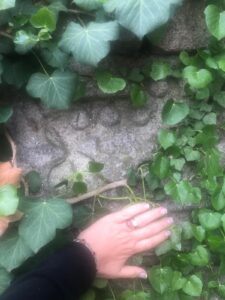
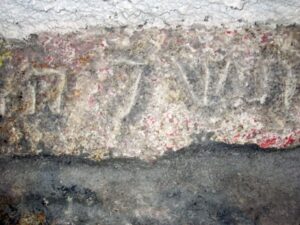
A Hebrew inscription in the basement of Major Afonso’s house.
Today, as Jewish communities in Portugal are returning and flourishing in Lisbon, Porto, Belmonte, and other places, and as the descendants of Anusim seek to rediscover their roots, the Rebordelo manuscript takes on a new meaning.
It is not merely a relic of the past. It is a call from the past to the present.
It asks us to question: Which prayers were preserved outside the formal prayer book? Which women upheld Judaism without their names ever being written? Which customs appear small, yet hold an entire history within them? And what else lies, to this day, beneath the floorboards of Jewish memory?
By Ruth Ariel (Calvão), co-author of the Inter-Aid project.
The entry is based on the testimony and research of Ruth Ariel Calvão, a partner in the Inter Aid project, and on documentation collected in the Tras os Montes region.
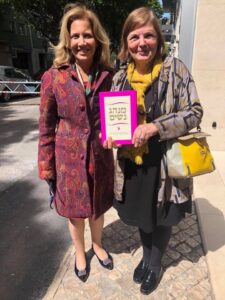
The “Women’s Prayer” project began two decades ago as a book that documented and collected Jewish women’s prayers throughout history. The book, which became a bestseller, revealed an entire world that had almost disappeared from our sight – a breathing and vibrant Jewish-feminine space that reflects a Jewish life story that was almost never told through conventional historical tools.
Today, marking 20 years since the book’s publication, we are proud to expand the project to a new format of prayer cards, combining the ancient prayers together with images from a stunning Judaica collection (courtesy of the William Gross Collection, photography: Arnon Barmucha).
The cards are intended for daily use, personal contemplation, family ceremonies and community activities – they invite us to return and reconnect with the rich feminine tradition that passed from mother to daughter throughout the generations.
Women’s Prayer Cards (Tefilat Nashim)
We use cookies to ensure the website functions properly and improve user experience. You can choose which types of cookies to enable.
Join us for women's prayer
A connection to the Jewish story through women’s voices Join to receive sources, prayers, rituals and stories from the Jewish female tradition.