Font "Noa" - Handwriting That Became Living Letters
On this website, we use a special font created from the handwriting of Lookout Noa z”l, who fell on October 7th at the Nahal Oz outpost at age 20.
Noa was full of joy and energy, loved music and dance, and dreamed of traveling the world and making it a better place. Her friends remember her as a source of inspiration who always performed her duties with professionalism and pride. She received her commander’s beret with the dedication: “The light in your heart will overcome any obstacle on the way to your goal.”
The font was created as part of the “Living Letters” project – a moving initiative that transforms the handwriting of fallen soldiers into digital fonts, so their words continue to live and make an impact.
Just as Noa dreamed – even after she’s gone, the light in her heart continues to overcome every obstacle and do good in the world.
Following the Prayer Book of Antje Mesritz-van Gelder
One Book That Started a Journey
“A friend of mine has an old prayer book that belonged to her grandmother. Maybe it will interest you.” This is how a research journey we didn’t anticipate began. A few days later, I spoke with Sivan Geffen from Nahariya. Her family has preserved for generations a prayer book bearing on its cover, in gold letters, the name: Antje Mesritz-van Gelder. From the family information gathered so far, it appears that Antje was born in the city of Winterswijk in Holland. Her husband was born in the city of Nijkerk. Beyond that, almost no family information remains. But the prayer book remains; sometimes a prayer book knows how to tell what memory has already forgotten.
A Prayer Book Intended for Women
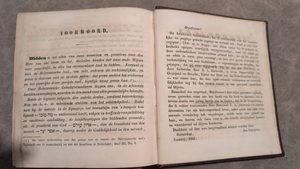
Examining the book reveals that it is an edition printed in Rotterdam in 1857.
This is a bilingual prayer book, where the text of the prayer appears in Hebrew alongside
a Dutch translation. However, the great innovation is revealed right on the first page.
The author addresses the reader with the words: “Madam!” (Mejuffrouw)!
The direct address to women was not to be taken for granted in the mid-nineteenth century.
Immediately afterward, he explains that he edited and translated the book primarily for women and youth, out of a desire to make the world of prayer accessible even to those who are not fluent in Hebrew. In other words, this is not merely a technical translation,
but an educational approach asserting that women, too, have the right to understand the words of the prayer and not just recite them.
The Prayer Book with the Preface Noting It Is Intended for Women and Youth
Equally interesting is the reasoning added by the author.
He emphasizes that the choice to dedicate the book
to women does not stem from a perception of inferiority,
but rather from a profound appreciation for their spiritual and moral capabilities. According to him, women deserve
to be full partners in the service of God, and therefore also deserve a prayer book they can understand.
This stance, written in Rotterdam in January 1857,
reflects an educational spirit relatively progressive for its time, illustrating the accessibility processes that Jewish communities in Western Europe underwent in the nineteenth century.
The prayer book’s introduction also teaches much about its author’s worldview.
He opens with the sentence: “To pray means to express our wishes and our feelings before God.” From here, he explains why it is fitting for a person to pray in a language they understand. However, he emphasizes that the Holy Tongue adds a spiritual depth that other languages lack, which is why he chose not to replace the Hebrew but to append a Dutch translation to it. One can see here a fascinating attempt to bridge two worlds: loyalty to the Hebrew tradition, alongside the desire for women and youth to understand the meaning of the words they
are saying.
A Dedication to a Woman
Another detail worthy of attention is that the book opens with a personal dedication
to a woman, the granddaughter of the Chief Rabbi, Rabbi H. Y.L. Herzfeld, who served as the Chief Rabbi of Overijssel and Drenthe. The author wishes to place her name at the beginning of the book as a token of appreciation to her family and in memory of the rabbi, and explicitly expresses his esteem for her as well.
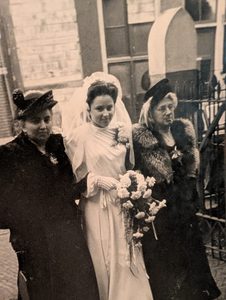
Antje, to whom the prayer book was dedicated at her son’s wedding.
The very fact that a women’s prayer book opens with a personal address to the reader and a dedication to a woman strengthens the feeling that this is not a book intended merely to “accompany” men’s prayer, but a work seeking to grant a place of honor to the spiritual world of the Jewish woman. The leather binding,
the name embossed in gold, and the fact that the book has been preserved for generations indicate that this was not a public book.
It was a personal book. It may have been given to Antje on the occasion of her marriage. It may have been a family gift.
It may have been inherited. At this stage, we do not know.
But it is clear that it accompanied one woman throughout her life. Such a prayer book is not merely an object. It is a testimony.
Jewish Women in Holland
In the nineteenth century, Dutch Jewry underwent processes of modernization
and integration into general society. The Dutch translation reflects the new reality,
in which many women were no longer fluent in Hebrew, yet sought to understand the meaning of the prayers. Books of this kind demonstrate that alongside the desire
to preserve the traditional prayer text, an attempt was also made to make it accessible to women and the younger generation. This is a crucial expression of the place of women in the world of prayer of Dutch Jewry. The research continues.
Much remains hidden.
Who was Antje Mesritz-van Gelder?
When did she receive the prayer book?
In which community did she pray?
How did the book pass from generation to generation until it reached Israel?
The prayer book opened a door. Now the research begins.
Credit
This entry is based on the personal prayer book of Antje Mesritz-van Gelder,
preserved in the family of Sivan Geffen, and on preliminary research.
The “Women’s Prayer” project began two decades ago as a book that documented and collected Jewish women’s prayers throughout history. The book, which became a bestseller, revealed an entire world that had almost disappeared from our sight – a breathing and vibrant Jewish-feminine space that reflects a Jewish life story that was almost never told through conventional historical tools.
Today, marking 20 years since the book’s publication, we are proud to expand the project to a new format of prayer cards, combining the ancient prayers together with images from a stunning Judaica collection (courtesy of the William Gross Collection, photography: Arnon Barmucha).
The cards are intended for daily use, personal contemplation, family ceremonies and community activities – they invite us to return and reconnect with the rich feminine tradition that passed from mother to daughter throughout the generations.
Women’s Prayer Cards (Tefilat Nashim)
We use cookies to ensure the website functions properly and improve user experience. You can choose which types of cookies to enable.
Join us for women's prayer
A connection to the Jewish story through women’s voices Join to receive sources, prayers, rituals and stories from the Jewish female tradition.