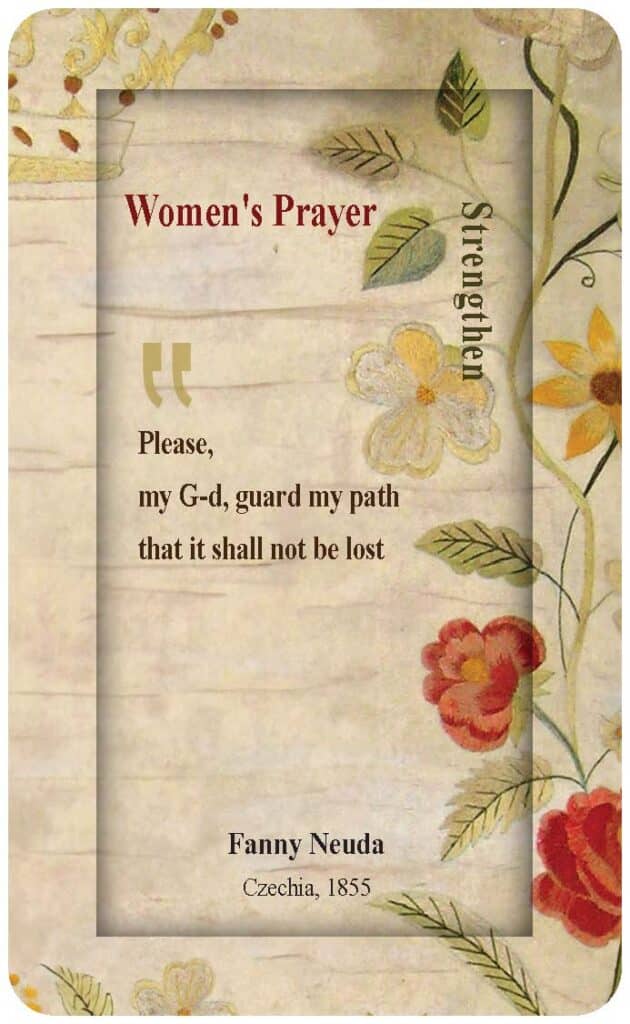
“Please, my G-d, guard my path that it shall not be lost”

Word of Inspiration

Time and Place

Prayer Content

Rare Judaica Item
Courtesy of the Gross Family

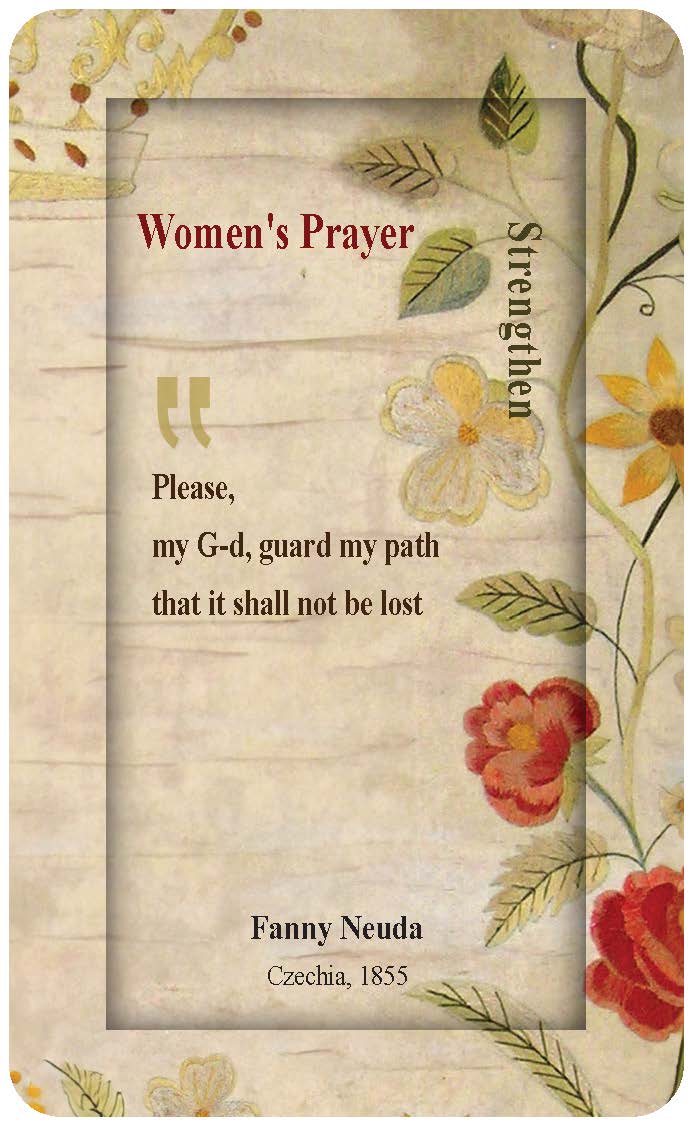
“Please, my G-d, guard my path that it shall not be lost”

Bohemia, 1855

word of inspiration: Strengthen 

The year 1855 was a time of upheaval: secularization, change in the status of women, waves of immigration and the beginning of the influence of the surrounding culture on the Jews. Fanny Neuda’s request, “Guard my path” , is not only a personal plea but also a reflection of a Jewish-feminine identity that seeks to be preserved and heard even in an era
when traditional identity frameworks were weakening.

The card “Please, my G-d, guard my path that it shall not be lost” carries within it a movement of searching, reverence and a gentle plea for a clear way in a changing world. It is a prayer that echoes the voices of many women throughout the generations, women who held fast to faith even more so when everything around them was collapsing, women who continued even when they had lost the signs along the way.

The short sentence is written in simple and direct language, yet it carries emotional depth, a quiet prophecy and courage. Like all of Fanny Neuda’s life’s work, quoted in other cards as well, this card seeks to make it possible for women to pray in a language that is close to the heart.

The prayer on the card was written by Rabbanit Fanny Neuda, an educator, creator and spiritual figure who lived in Bohemia in the 19th century. She was the first Jewish woman to write and publish a prayer book for women and girls in the German language, out of a sense of mission and a desire to bring women who did not know Hebrew back into the Jewish world of prayer.

Her book Hours of Devotion, first published in 1855, became a bestseller across continents and cultures. It was passed from mother to daughter, serving as a source of comfort and prayer for women in Europe,
the United States and Israel, placed sometimes instead of the traditional prayer book and sometimes alongside it.

In her writing, Fanny blazed a trail, creating personal, human and precise prayers: for a bat mitzvah, for a bride, for a woman giving birth, for a mother whose son was ill, for women who experienced loss or loneliness
and for those seeking livelihood, love or strength. Fanny hoped that:

“Prayers born out of the experiences of a woman will find an echo in the hearts of women and give them strength, comfort and elevation of spirit”.
About the Image:

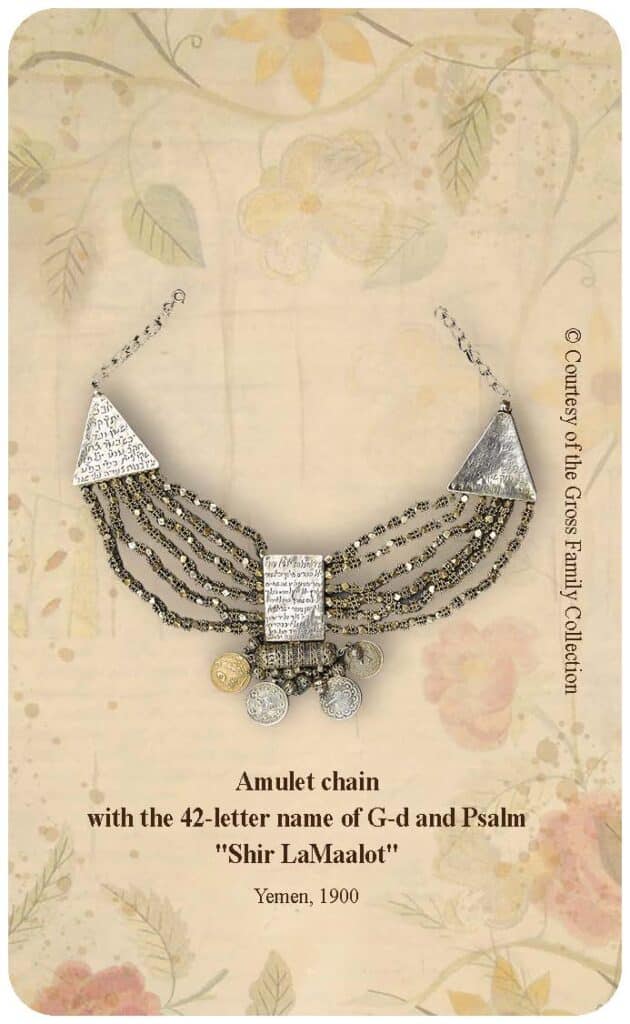
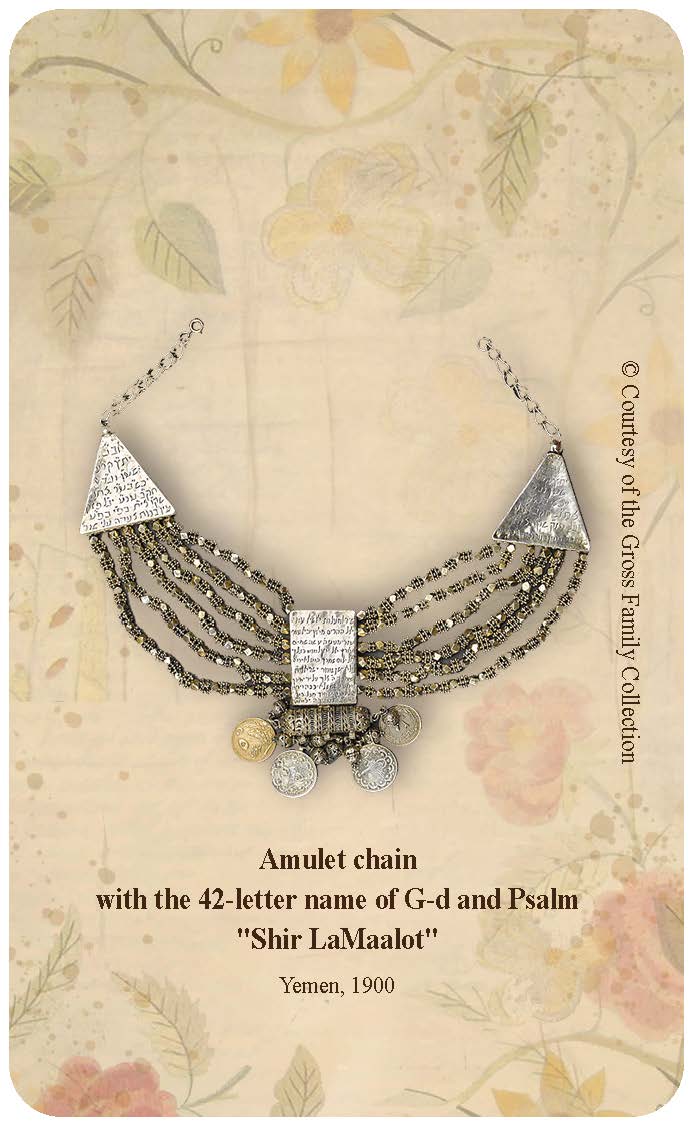
Amulet necklace, Yemen, 1900

The rare necklace featured on the card is made of hand-engraved silver and contains holy names, verses for protection and Psalm 121. This piece of jewelry belongs to a long tradition of Jewish women in Yemen, who wore such amulets for protection, strength and spiritual accompaniment throughout life’s journey: in childbirth, in travel, in moments of danger or change.

The decorations and inscriptions are not only charms,
but a language of faith imprinted in material.
Like Fanny Neuda’s prayer, “Please, my G-d, guard my path that it shall not be lost” , the amulet expresses a gentle request for steadfastness, direction and inner protection in times of uncertainty. In the connection between the prayer and the amulet lies a quiet strengthening, not a cry but a faith kept close to heart. Sometimes as words, sometimes as jewelry and sometimes as a memory.

The amulet and the prayer together tell of women who searched for a way and carried a prayer with them, even when Hebrew was unfamiliar,
even when they had no words.

An Invitation to Reflect:

This card offers us a moment of stillness and of standing on the threshold.
The gentle yet insistent request, “Please, my G-d, guard my path that it shall not be lost” resonates as a personal plea, but also as a declaration of a feminine identity seeking to be heard in a changing world.
Between the lines of Fanny Neuda’s prayer lies an ancient yet living feminine voice. A voice that seeks to break into life precisely from within uncertainty.
Between the prayer book Fanny offers and the amulet shown on the card, the same inner request emerges despite the difference in form of expression.
Which of these expressions touches you more? The prayers or the amulets? What does this awaken in you?


Inspiration for Using the Card:

The power of Women’s Prayer Cards in exploring identity, belonging and the search for meaning.

Personal Process

The prayer on the card was born from a feminine heart searching for a way, answered in simple, compassionate and present language.
Questions for personal reflection:
Which path in your life do you seek to preserve right now?
Where within you does a quiet plea arise for “Guard my path” in the midst of chaos, change or transition?
Writing exercise: Upon drawing the card, write to yourself: “Today, my path is…” “The things that threaten this path are…” “I ask to protect…”

Discussion Circle

The card presents a prayer written more than 150 years ago by Fanny Neuda, an educator, author of a women’s prayer book and a trailblazer forgotten from the pages of history. Only recently have her prayers returned to the light.
Suggestion for the circle:
“Hidden Amulet” – each participant is invited to think of a small thing she carries with her, physically or in her heart, that gives her strength, a sense of protection or a reminder of her path (an object, a picture or simply sharing in words).
Questions for the circle:
What is the path I am walking these days?
What within me do I feel needs protection?
What has disappeared or been forgotten in me that I wish to reclaim?

Emotional and Therapeutic Work

Opening emotionally, connecting to the card:
What feeling arises in me when I hear the request in this prayer?
Is there a path within me that needs guarding? Perhaps an identity, a value, a dream?

Imagery work: drawing or collage
Invite the participant to create a map of the road that marks “my journey” so far, with signs, turns and paths that have disappeared.
For those who find drawing difficult, choose images from magazines and design a collage
of “guarding my path”.

Processing questions:

What is the voice within me that needs protection?
Which old prayers (or dreams) have returned to me through the card?
Is there a part of me that was forgotten like Fanny Neuda and seeks recognition?


To Deepen

Fanny Neuda, Hours of Devotion, 1855 (Aliza Lavie), 2014, Yedioth Books.

This card is especially suited for therapeutic work in situations of:
Women in a stage of transition (separation, childbirth, return to self)
Emerging feminine identity (teenagers, late adolescence)
Those who feel their personal voice is “almost forgotten”
Processing delicate trauma or repressed female family heritage.


Psalm 121
[1] A Song of Ascents
I will lift up mine eyes unto the mountains: from whence shall my help come?
[2] My help cometh from the LORD, who made heaven and earth.
[3] He will not suffer thy foot to be moved; He that keepeth thee will not slumber.
[4] Behold, He that keepeth Israel doth neither slumber nor sleep.

Between Words and the Wisdom of the Heart

About three weeks before her arrest, on July 15, 1944, Anne Frank wrote in her diary:

“In spite of everything I still believe that people are truly good at heart”. 

Even within a reality of danger, persecution and isolation, Anne wrote this sentence. It is not only an expression of optimism but a deep testimony of inner loyalty, of her ability not to lose the way, not to renounce her belief in the fundamental good in the world even when all of reality contradicted it.

Click me

Women’s Prayer Cards (Tefilat Nashim) We use cookies to ensure the website functions properly and improve user experience. You can choose which types of cookies to enable.
Cookie Selection


Join us for women's prayer

A connection to the Jewish story through women’s voices
Join to receive sources, prayers, rituals and stories from the Jewish female tradition.