Following Judith
The Festival of the Daughters, prevalent mainly in North African communities,
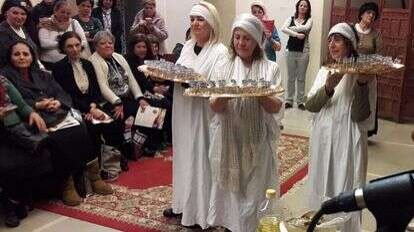
has ancient roots, and its origin is likely a female celebration preserving the memory of the story of Judith and Holofernes. The women in the communities of Libya, Tunisia, Algeria, Constantinople, and Salonika refrained from working on this day. Young women would visit one another and hold joyful gatherings. In some communities, it was customary to hold a joint bat mitzvah ceremony for all the girls who came of age that year. But mostly it was a “bonding” event for all the women of the family, where they would reconcile with one another, pray together, eat dairy holiday foods together, in memory of the milk Judith gave, drink wine, in memory of the army commander’s drunkenness, and dance, in memory of the dances the women danced when Judith returned home with the commander’s head.
The Book of Judith, one of the Apocrypha, tells the story of Judith, a beautiful young widow who lived in a city besieged by an enemy under the command of the general Holofernes.
Judith entered Holofernes’ camp, and he was captivated by her great beauty and prepared
a banquet in her honor. During the banquet, Judith gave Holofernes drinks until he was drunk, cut off his head, and saved the people of her city.
Although the book itself describes Holofernes as an Assyrian general who likely operated during the First Temple period, there are ancient traditions linking the Judith event to the Hasmonean period and the Hasmonean revolt. Some traditions link Judith directly to the sister of the Hasmonean brothers, Judith daughter of Mattathias, who killed the Greek general Nicanor and brought salvation to her people. Other traditions create a close connection between Judith’s actions and the demand “let her be wedded first to the governor”:
“And how did the Greek kings oppress them? By placing officers (officials) in the towns to abuse the brides, and only then were they married to their husbands” (Megillat Taanit Chapter 6). The Midrash of the Hanukkah Story tells of the initiative of the daughter of Mattathias who was about to be married and her actions to cancel this decree, until “Judah and his brothers entered with his sister to the governor and cut off his head and looted all that he had,
and killed his officers and servants.”
And so, alongside the Hanukkah candles that preserve the historical memory of the Hasmonean revolt, a female customary layer exists, strictly preserved, commemorating a brave female act of salvation, one tradition of which describes a woman who saved her people and another tradition describes a woman who rescued all her friends, saving them and the entire nation from the decree of legalized rape that occurred with no savior in sight.
The act of Judith, pushed to the margins of formal memory, and the Book of Judith, forgotten from the heart, found their remedy echoing in the female custom, the custom that preserved it forever in its vitality.
Not By Coercion
As my interpersonal encounters with elderly women expanded, I understood the power of the living memory that preserved these customs. The historical traditions were integrated into clothing styles, types of foods, and the nature of ceremonies, and thus were passed from generation to generation with precision and strictness, in a consistent and continuous process of preserving memory and religious practices, in the most tangible way possible.
The female custom is a central factor in preserving Jewish tradition throughout the generations, and it maintained its strength even in periods when male adherence to formal halacha dimmed and weakened in general, and in our days in particular. The memory of the special food, the unique ceremony, and the celebrating family are the foundation upon which the heritage-preserving longing is built: a school for Judaism kept modestly in the recesses of the home, bursting with great vitality on holidays in the form of a custom, which often has no trace in canonical texts, yet its impact is no less than theirs. The “chalk and blackboard” of the domestic sphere, the memory and the accompanying action, the customs of the day, and female-folk storytelling – all these were burned into the women’s memory.
However, precisely here, when the various communities returned home after hundreds and thousands of years of exile, the chain of tradition weakened and sometimes even broke.
The reasons are well known: the ingathering of the exiles, the move to a new country and the dismantling of the community, the Israeli establishment and its call for a uniform version, the disdain and also the shame of being different, and the desire to be like everyone else –
all these contributed to the weakening of the transmission.
The result is clear – the living tradition has not always found the standard-bearers of the next generation, and it is liable to be forgotten. In many homes, after the great-grandmothers passed away, the young women discovered that they hadn’t had time to ask. Sometimes the custom itself is still preserved, but the important precision in details has been lost from the world, and sometimes even the historical background story has already been forgotten. Traditions, texts, and rituals through which one can learn about female traditions and Jewish female knowledge passed down through them from generation to generation are in danger of disappearing.
In recent years, the Festival of the Daughters has been returning to the sphere and penetrating public consciousness, thanks to initiatives by communities and individuals. Thus, for example, the phenomenon of young women in the family bringing the custom back to the family is strengthening, as is “The Hebrew Core” (HaLuz HaIvri), the blessed initiative of Hali Tabibi Barakat, which leads the project to return holidays with Jewish meaning and content from the traditions of the Jewish communities to the communities and the sphere of Israeli life. From the power of Jewish-Israeli togetherness, and given the fact that the vast majority of the current generation is blessed with grandparents from all Jewish ethnic groups, various processes are intensifying, aimed at bringing ancient traditions back to life. This activity is slowly returning to the cycle of Israeli life the heartbeat of a Jewish world that was almost lost. Educational methods of tradition and heritage, reconciling, familial, and loving, which brought many generations to love Judaism from a place of connection and belonging rather than coercion, punishment, and fear – are more vital today than ever.
Published in Makor Rishon, 27 Kislev 5780.