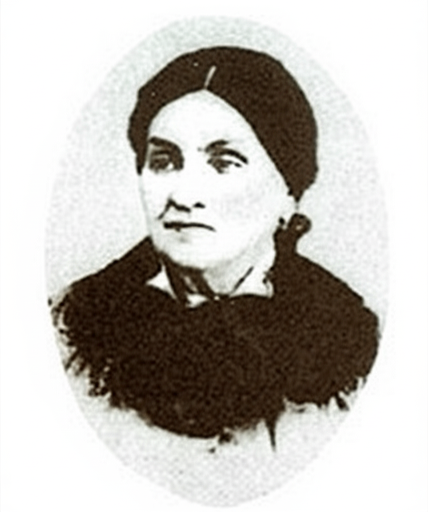
The Widow Romm Is Born
Novogrudok [Northern Belarus], December 3, 1831. The evening shadows fell over the ruins
of the ancient fortress wall and only the echoes of the battle between the Polish rebels and the soldiers of the Russian army disturbed the tranquility of the descending evening.
In the home of the Harkavy family in the center of the town cries of ‘Mazel Tov’ were heard.
A baby girl was born, and her name in Israel was Devora. Already from her childhood,
which passed pleasantly “among fields of gold, on the banks of a pure stream… where a sound falls in the heights during early spring, with the song of the swallow hidden in the depths of the sky,”
as the Polish poet Adam Mickiewicz, a native of Novogrudok, described the town’s landscape, Devora was surrounded by books. Tsarna Ita, Devora’s mother, a daughter of the renowned Strashun family, was ‘learned and educated and wonderfully wise’, and according to the testimony of her granddaughter she ‘subscribed to a German journal and told me the plots of Shakespearean tragedies’. Her father, among the first Jewish enlightened thinkers in this region, was described as ‘a swift writer in our holy language and a true lover of the literature of Israel’. On the shelves of the bookcase in the Harkavy home one could find, alongside volumes of the Babylonian Talmud and halachic books, a wide variety of Enlightenment literature, the best of world literature and popular science books. And as was customary in families that belonged to the circles of the Jewish Enlightenment Devora and her sisters were educated in light of the values of this worldview. As a result Devora mastered a variety of languages
[Polish, German, Russian and Hebrew], which allowed her to expand the horizon of her gaze to broad and diverse cultural realms.
And so it was regarding her marriage. Young Jewish women who belonged to Enlightenment circles perceived the institution of marriage as a space that offers not only a shared roof and economic security but also an ideological and cultural partnership between the couple, even if this meant marriage at an older age than was acceptable in Jewish society. And Devora, like her sisters, waited patiently until she found a partner who would share her worldview.
This is the reason why only upon turning twenty did she marry David, a member of the Romm family, owner of the famous printing press that operated in Vilna, the capital of scholarship and the cradle of Jewish Enlightenment in Eastern Europe.
However, nine years later David passed away, and the printing press was left without a manager. In the absence of a family member capable of continuing the family management tradition of the printing press she took advantage of the opportunity that came her way and in an exceptional step in the social reality of the time took it upon herself to fill her partner’s place. This move, which testifies to both her ambitions and her unique character, provided her with the opportunity to spread her wings. And she indeed soared high. Within a short period of time she positioned herself as the sole manager of the printing press, which from then on was called ‘The Press of the Widow and Brothers Romm’, purchased modern printing machines, implemented strict planning, production and quality control processes, and deployed a wide network of sales agents in Europe and even overseas.
During the years she managed the printing press, until her death in 1903, her press, which became the largest of its kind in the entire Jewish world, published over two thousand titles, including the Vilna Shas which is considered to this day as the most accurate and widely studied edition in the Jewish world.