Share:

Facebook
LinkedIn
WhatsApp

Making Shavuot Tangible

Pastries, cooking and the soul of the kitchen

Shavuot is associated with study, with a sleepless night of Torah, with the Book of Ruth.
But there is another ancient story, written in parallel.
A study that takes place in the kitchens of the communities.

There, through the creation of symbols in pastries and flavors, the meaning of the holiday
is passed from generation to generation.
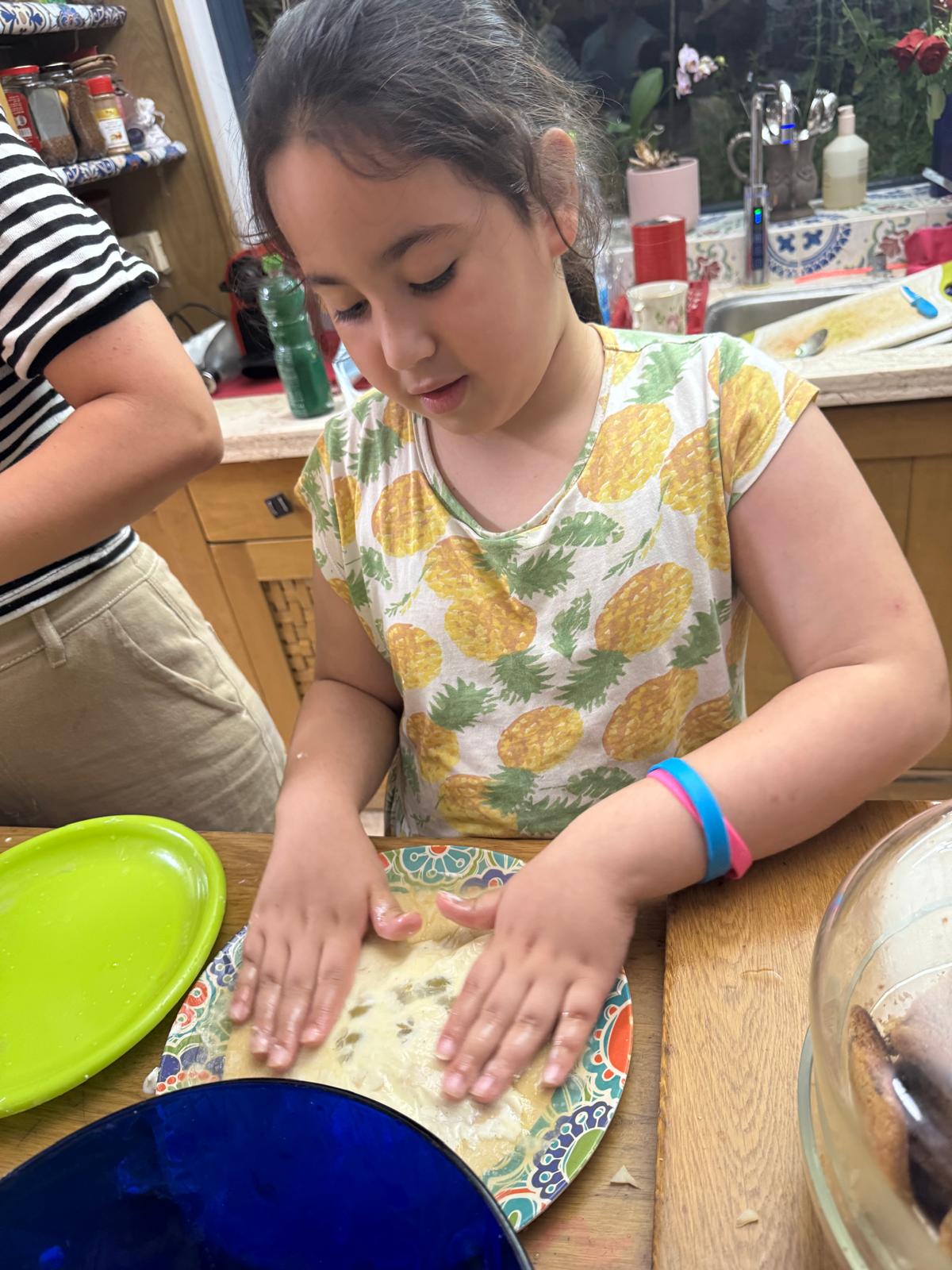
Not only through words but through experience.
Through working hands, and guiding conversation.

And these foods, more than they nourish the body,
They remind, signify, open a path.
Even for those who forgot, for those who did not know, for those who seek to remember anew.

Baking Traditions That Tell the Story of Shavuot

In Jewish communities, the Shavuot holiday is characterized by a variety of pastries
and cooked dishes that symbolize the holiday and its meanings.
The kitchen’s diverse ingredients serve as educational tools for conveying messages
and preserving tradition.
In Ashkenazi communities, cakes shaped like Mount Sinai called “Sinaikuchen” are baked,
built from seven layers corresponding to the seven heavens of glory.
In some communities, it is even customary to bake long bread, as a symbol that the Torah
is likened to bread and is long.
Sephardic Jewry prepares a seven layer cake called “Siete Cielos”, in memory of the seven heavens Moses passed through upon his ascent heavenward. This cake is decorated with a Star of David and a ladder representing Moses’ ascent to Mount Sinai.
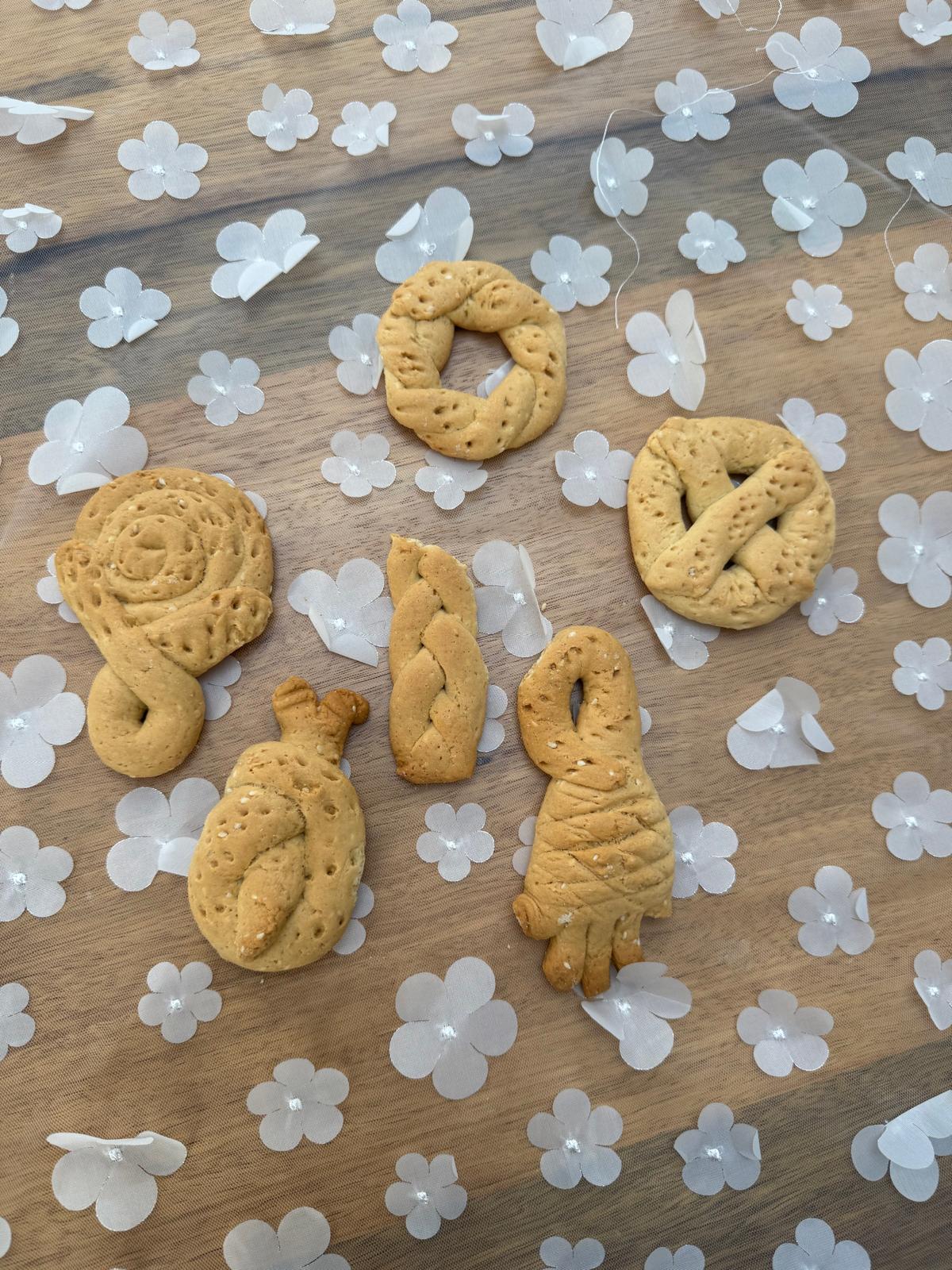
Concurrently, in Italian communities, it is customary to bake challahs in the shape of a ladder.
In many homes, wafers and challahs are baked according to the symbols of the holiday. Challahs shaped like a ladder symbolize the ladder Moses climbed on Mount Sinai to receive the Torah. Cakes shaped like a Hamsa represent the verse “I reach out my hand to receive the Torah”. Furthermore, wafers are baked in the shape of the Tablets of the Covenant and a dove (where the dove symbolizes the Assembly of Israel, as it is stated:
“The Assembly of Israel is likened to a dove”), alongside scissors cakes symbolizing the cutting of the parchment on which the Torah is written.

Dairy Foods

One of the holiday’s customs is eating dairy products. Many reasons have been given
for this custom, the main one being related to the likening of the Torah to milk and honey,
as it is stated: “Honey and milk are under your tongue” (Song of Songs 4:11).
The source of the custom to eat dairy foods on Shavuot is already mentioned in the books
of the Rishonim; for example, in the “Kol Bo” book it is written: “It is customary to eat honey and milk on the Shavuot holiday because the Torah is likened to honey and milk as it is written
‘honey and milk are under your tongue'”.

In the communities of Poland and Lithuania, the women of the family used to decorate
the windows of the house with various animals and birds cut from paper
(“Shavuotlach” or “Royzelach”).

In the Persian Jewish community, the Shavuot holiday is called “Mo’ed Gul”
(a corruption of Mo’ed Gul, the festival of flowers, where tables are decorated with fragrant flowers). Sweet porridges are prepared, such as “Halva Khurma” made from dates with the addition of semolina, oil and sugar, or “Halva Berenj” made from rice with oil, water, sugar
and various spices. The father of the family blesses his wife: “Sad sal be in salhaye khoob beresi” (May you merit a hundred such good years), and she blesses back: “Shoma ham sad sal be in salhaye khoob beresid” (You too, may you merit a hundred such good years).
After the Kiddush, a blessing is recited over the seasonal fruits.

We chose to tell the story of the kitchen specifically around the Shavuot holiday,
because in this holiday the artistic and symbolic creation within it stands out. The pastries, shapes, symbols and flavors all become a language of storytelling and knowledge transmission, not just as study but as a living experience. And perhaps this is also the place for the cheesecake competition, which has become central in recent years ahead of the holiday, and on social networks many share recipes and recommendations.
This is a communal gathering that continues an ancient tradition through new means.
Even in the digital space, in the many cooking shows just like in the past, women and men create, taste and share, and the kitchen returns to serve as a space of creation,
identity and belonging.

A Blessing Before Cooking

Many women from various communities have a custom to recite a blessing
at the beginning of cooking: “Everything that I cook, may it be eaten in joy without quarrels and without strife, may it be eaten for health, for joy and for love,
and with the help of God we will do and succeed.”

A recommendation for successful cooking was found from Rabbi Chaim ben Yitzchak, a figure of the 13th century: “And a woman acts astutely on a festival and cooks a full pot even though she only needs one piece, because it cooks better when the pot
is full. And similarly, they bake a full oven even though only one loaf is needed,
because it bakes better when the oven is full.”

About Us | Women's Prayer Project

The “Women’s Prayer” project began two decades ago as a book that documented and collected Jewish women’s prayers throughout history. The book, which became a bestseller, revealed an entire world that had almost disappeared from our sight – a breathing and vibrant Jewish-feminine space that reflects a Jewish life story that was almost never told through conventional historical tools.

Today, marking 20 years since the book’s publication, we are proud to expand the project to a new format of prayer cards, combining the ancient prayers together with images from a stunning Judaica collection (courtesy of the William Gross Collection, photography: Arnon Barmucha).

The cards are intended for daily use, personal contemplation, family ceremonies and community activities – they invite us to return and reconnect with the rich feminine tradition that passed from mother to daughter throughout the generations.

Our Books

Women’s Prayer Cards (Tefilat Nashim) We use cookies to ensure the website functions properly and improve user experience. You can choose which types of cookies to enable.
Cookie Selection


Join us for women's prayer

A connection to the Jewish story through women’s voices
Join to receive sources, prayers, rituals and stories from the Jewish female tradition.