Share:

Facebook
LinkedIn
WhatsApp

Stefania Wilczyńska: Choosing to Stay

On Responsibility, Education, and the Choice Not to Stand Idly By

When people speak of the Jewish orphanage in Warsaw, Janusz Korczak’s name is familiar
to almost everyone. Yet alongside him, for more than three decades, worked an extraordinary Jewish woman who founded, managed, and sustained the home day after day:
Stefania – Stefa – Wilczynska.

Stefa was not merely Korczak’s right hand. She was an educational leader in her own right:
a woman who knew how to turn grand ideas into a daily routine, responsibility, and action.
who saw every single boy and girl, and who, at the decisive moment, chose to stay with the children of the orphanage even though she could have been saved.

Her story raises a broader question: What makes a woman a Jewish leader?
Is it necessarily a deep familiarity with sources and customs, or does Judaism sometimes reveal itself precisely through one’s pattern of life in responsibility, loyalty, and the refusal to abandon the vulnerable?

From a Cultured Jewish Home to the Children of the Jewish Street

Stefania Wilczynska was born in Warsaw in 1886 to an affluent and educated Jewish family. She grew up apparently in an assimilated bourgeois environment and was far from knowing tradition. She received a broad education and studied natural sciences at the universities
of Liège and Geneva.
She could have chosen a comfortable and protected life, but she returned to Warsaw and turned precisely to the place where distress was greatest: a shelter for Jewish orphans
and destitute children. At first she volunteered, but within a short time her organizational skills, dedication,
and ability to see the children’s needs became apparent, and she took upon herself the management of the place.
She sought to reach not only visible poverty – the kind that cries out in the streets and appeals to institutions – but also “hidden poverty”: families and children who bore their distress quietly and sometimes even felt ashamed to accept help. To this end, she recruited wealthy women from Warsaw and built a circle of female aid for the sake of the children.
Already at the beginning of her path, a trait that would accompany her all her life was evident:
she did not suffice with pity. She created a system of responsibility.

Not Merely Korczak’s Partner

In 1909 Stefa met the physician and educator Dr. Henryk Goldszmidt, who later became known by the pen name Janusz Korczak. She invited him to join the work of the orphanage,
and the two formed an educational partnership that lasted for decades. Korczak was the writer, the thinker, and the public figure. Stefa was largely the one who turned the ideas into daily reality. She managed the orphanage, planned the daily routine, guided the staff,
and trained generations of educators.
When Korczak was drafted into the army during the First World War, Stefa remained solely responsible for a home that expanded to include about a hundred and fifty children,
under conditions of hunger, cold, and disease. Testimonies of those who lived and worked beside her describe a tall, focused woman, dressed in a black apron with a bundle of keys hanging from her arm. She was everywhere: caring for the sick, bandaging wounds, checking accounts, accompanying the guides, arranging meals, and following the condition of every child. She knew who had not eaten, who was not sleeping, who was afraid, and who needed a kind word. She documented the height and weight of the children, their habits, their arguments, and their dreams. Even small details, like a personal towel hook or clothing that was not identical to everyone else’s, had meaning in her eyes: every child has a name, a place, and a distinct identity. This was leadership that did not seek a stage, a leadership that knew great responsibility is built from thousands of small deeds.

A Home of Respect for the Child

The orphanage managed by Stefa and Korczak was an innovative educational laboratory. Unlike many institutions of the period that viewed children as a group to be disciplined and restrained, they sought to see in every child a complete human being possessing desires, thoughts, rights, and responsibility.
The children had institutions of their own: a court, a parliament, committees, and a newspaper. They participated in running the home and learned that freedom is not an exemption from responsibility, but an invitation to be partners.
The division between Korczak and Stefa was clear, but unequal in public memory.
He formulated the ideas and published them; she built the mechanisms that enabled them to exist. The staff members knew how much she contributed to his educational conclusions and even to his writings, but for many years her figure remained in his shadow.
Precisely for this reason, it is important to restore her place to her: not as the assistant of a great educator, but as an educator and leader who by her own strength shaped one of the most important educational enterprises of the twentieth century.

Far from Tradition and Connected to the People

Stefa did not grow up in a traditional home and was not well-versed in Jewish customs.
Yaakov Tzuk, who lived in the orphanage for years and knew her closely, testified that she was far from religion and the knowledge of tradition. And yet, she knew how to respect the world of the children and the holidays that gave them a sense of home and belonging. Tzuk described how on the eve of Yom Kippur, when the atmosphere of the Days of Awe filled the house, Stefa would sit among the female trainees, look through photo albums with them, and raise memories from the years gone by.
On Passover nights, when the large hall was lit, the children read the Haggadah and sang songs of the Land of Israel. At those moments, he wrote, tears flowed from Stefa’s eyes –
even though she usually knew how to restrain and hide her feelings.
Through the children, the holidays, the Hebrew language, and the connection to the Land of Israel, Judaism became for her not merely a family origin, but a living responsibility.
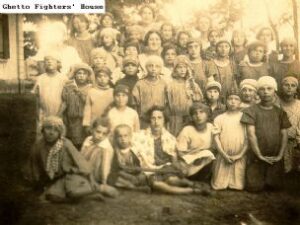
Stefania Wilczynska with the female trainees of Korczak’s orphanage. Courtesy of the Ghetto Fighters’ House Museum / Photo Archive.

Ein Harod and the Possibility of Another Life

The connection with guides and trainees who immigrated to the Land of Israel aroused in Stefa a growing interest in the Zionist enterprise and in kibbutz education. She arrived in the country several times, stayed in Ein Harod, and worked with the children of the kibbutz. There too, she did not suffice with observing from the sidelines. She wrote notes, examined educational routines, and suggested ways for improvement. She saw in the Land of Israel a possibility for the continuation of her life and work and even helped strengthen Korczak’s connection to the country.
Yet in 1939, when fears regarding the fate of Polish Jewry grew, she decided to return to Warsaw. She knew she was leaving a safe place and returning to a place of danger. Before her departure, she wrote that in the situation that had arisen, her place was with Korczak and the children; this was a conscious decision.
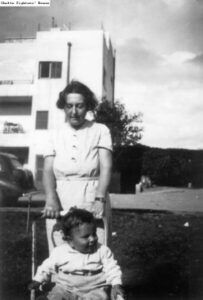
Stefania Wilczynska visiting Kibbutz Ein Harod in 1938. Courtesy of the Ghetto Fighters’ House Museum / Photo Archive.

“Without the Children, I Will Not Go”

With the Nazi occupation, the orphanage was transferred to the Warsaw Ghetto.
Hunger, crowding, and disease made life nearly impossible, but Stefa and Korczak tried to continue maintaining a home for the children that had order, responsibility, and human dignity.
Her friends in Ein Harod tried to help her leave Poland. She had a real opportunity to save herself, but she refused.
In a letter sent to her friend Feiga Bieber, she wrote: “I did not come to you, because I have no intention of leaving without the children.” And in another letter: “We are working in the orphanage. Without the children, I will not go.”
These are not words of someone who did not understand the danger.
These are the words of a woman who understood well and nevertheless chose. For the responsibility she took upon herself does not end when the price becomes heavy.
On August 5, 1942, the order was received to deport the children of the orphanage.
Stefa, Korczak, and the staff members marched with the 192 children to the Umschlagplatz,
from which they were sent to Treblinka. Stefa was in charge of the group of children aged nine to twelve. She remained with them until the very last moment.


What Makes Stefa a Jewish Leader?

Stefa’s life presents us with a profound model of Jewish leadership.
This is a leadership measured not only by what a person says about their identity,
but by what they are willing to bear for it. Stefa saw the Jewish children entrusted to her hands not merely as trainees, but as human beings for whom she was responsible. She built them a home, preserved their dignity, provided them with order and meaning, and at the hour of testing, refused to separate her fate from theirs. In the Jewish tradition, responsibility is not merely an emotion. It is a commitment to action.
From the commandment “Do not stand idly by the blood of your neighbor,” through mutual guarantee, to the obligation to protect the orphan, the demand not to avert one’s gaze recurs time and again. Stefa lived out this demand with her body and through her deeds.

To Remember Her by Name

For years, Stefa was remembered primarily as the one who went with Korczak
and the children to their deaths. Yet her final act of heroism was a direct continuation
of a lifetime of dedication, leadership, and responsibility. She did not remain with the children only on the day of the deportation. She stayed with them every morning she made sure they ate. Every night they sat by the bedside of a sick child.
Every decision where she insisted on seeing the individual within the group.
Every time she turned an educational idea into a safe place where one could live.
The story of Stefania Wilczynska invites us to broaden our perspective on Jewish women’s leadership. Not only women who wrote, delivered sermons, or headed official institutions, but also women who built systems of life, bore daily responsibility,
and held a community together in moments of crisis.
She grew up far from tradition, but her life became a profound testimony to Jewish mutual guarantee.
Not in words – but in presence.
Not in a title – but in responsibility.
Not in a single moment of heroism – but in a lifetime in which she chose, time after time, not to stand idly by.
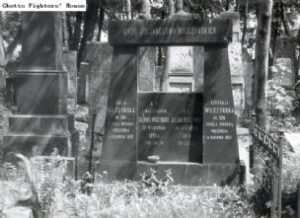
The gravestone of Stefania Wilczynska and her sister Julia in the Jewish Cemetery in Warsaw. Courtesy of the Ghetto Fighters’ House Museum / Photo Archive.

Sources

Yaakov Tzuk, “In the Presence of Janusz Korczak and Stefania Wilczynska,”
Ofakim le-Chinuch u-le-Tarbut, Year 9, Issue 4, 1955.

About Us | Women's Prayer Project

The “Women’s Prayer” project began two decades ago as a book that documented and collected Jewish women’s prayers throughout history. The book, which became a bestseller, revealed an entire world that had almost disappeared from our sight – a breathing and vibrant Jewish-feminine space that reflects a Jewish life story that was almost never told through conventional historical tools.

Today, marking 20 years since the book’s publication, we are proud to expand the project to a new format of prayer cards, combining the ancient prayers together with images from a stunning Judaica collection (courtesy of the William Gross Collection, photography: Arnon Barmucha).

The cards are intended for daily use, personal contemplation, family ceremonies and community activities – they invite us to return and reconnect with the rich feminine tradition that passed from mother to daughter throughout the generations.

Our Books

Women’s Prayer Cards (Tefilat Nashim) We use cookies to ensure the website functions properly and improve user experience. You can choose which types of cookies to enable.
Cookie Selection


Join us for women's prayer

A connection to the Jewish story through women’s voices
Join to receive sources, prayers, rituals and stories from the Jewish female tradition.