Share:

Facebook
LinkedIn
WhatsApp

Dr. Sarah Friedlander:
A Voice of Historical Responsibility

“There are women whose voices are preserved in the words they wrote.
And there are women whose voices are preserved in the words they saved.
‘Dr. Sarah Friedlander was one of the latter,’ explains Shlomit Sattler, the Educational Director
of the Herzl Center: ‘Her work reveals a profound worldview of commitment to memory, testimony, and documentation. From that consciousness, she acted upon the belief
that memory is not merely the past, but a responsibility. For her, collecting testimonies
was not just a research activity, but a moral obligation toward future generations.’

Dr. Sarah Friedlander (1914–1948) was an exceptional figure who embodied a rare continuum between an intellectual Zionist spirit in pre-Holocaust Europe, moral resilience during
the persecution, and the building of the national infrastructure of memory in the Land of Israel. She was born in Budapest and raised in an educated Jewish environment,
acquired high academic education, and completed a doctorate in philosophy and philology
at the University of Budapest a particularly exceptional achievement for a Jewish woman
in Hungary of the 1930s.

Already in her youth, she stood out as an ideological and organizational leader:
she founded a Zionist library, published research articles on Herzl, Henrietta Szold, and Bialik, was active in the leadership of Zionist movements, and held key positions within Keren Hayesod. For her, Zionism was not a slogan but a cultural-historical project that must
be anchored in knowledge, research, and national consciousness.”
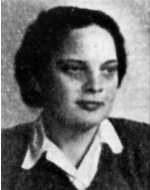
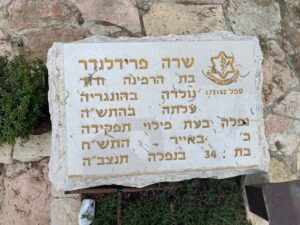
Dr. Sarah Friedlander

With the tightening of the racial laws and the Nazi occupation in Hungary,
she continued her public activity and assisted persecuted Jews, until she was arrested
and transferred to the Bergen Belsen concentration camp. Even during the harsh period of imprisonment, she did not abandon her intellectual identity and her sense of historical mission.

The camp experience sharpened her realization that beyond physical survival,
there was an urgent duty to save the memory as well – to document, collect, record,
and ensure that the world would know what happened to the Jewish people.

After her liberation and immigration to Israel in 1945, this concept became practical action.

In Jerusalem, she was among those who laid the foundations for the Yad Vashem archive
at the beginning of its journey, and she served in a central role in managing and collecting materials. At a time when systematic methods for Holocaust research had not yet been established, she brought with her research thinking, archival order, and intellectual discipline.

She understood that without systematic documentation of documents, testimonies,
name lists, and source materials, an essential dimension of the catastrophe would be lost,
and the memory would become a vague legend instead of grounded history.

Much like many women who acted on the fringes of recorded history,
Friedlander also acted out of a quiet yet decisive sense of mission to preserve, collect,
and pass the story forward. Not only as documentation of the past, but as a promise
for the future.

Her work reflects a profound concept: the revival of the Jewish people requires not only military defense but also the construction of reliable and accurate historical memory.
Therefore, she should not be seen merely as a Holocaust survivor or a casualty of the War
of Independence, but as a woman of intellect and action who connected the experience
of destruction with the creation of infrastructure for research and commemoration.

Her fall in Jerusalem in May 1948 while serving as a medic in the War of Independence cuts short a life that was entirely dedicated to historical responsibility.

Sarah was laid to rest in the military cemetery on Mount Herzl,
in the city where she chose to start her life anew after the Holocaust,
and her burial place is near the great memorial installation of Yad Vashem,
which she was among its founders.

Thus, between the words she did not have time
to write and the testimonies she managed to save, Sarah Friedlander’s voice remains alive,
not only in the memory of the past,
but in the responsibility we carry to continue and tell the story.

Courtesy of Shlomit Sattler, Educational Director, Herzl Center

About Us | Women's Prayer Project

The “Women’s Prayer” project began two decades ago as a book that documented and collected Jewish women’s prayers throughout history. The book, which became a bestseller, revealed an entire world that had almost disappeared from our sight – a breathing and vibrant Jewish-feminine space that reflects a Jewish life story that was almost never told through conventional historical tools.

Today, marking 20 years since the book’s publication, we are proud to expand the project to a new format of prayer cards, combining the ancient prayers together with images from a stunning Judaica collection (courtesy of the William Gross Collection, photography: Arnon Barmucha).

The cards are intended for daily use, personal contemplation, family ceremonies and community activities – they invite us to return and reconnect with the rich feminine tradition that passed from mother to daughter throughout the generations.

Our Books

Women’s Prayer Cards (Tefilat Nashim) We use cookies to ensure the website functions properly and improve user experience. You can choose which types of cookies to enable.
Cookie Selection


Join us for women's prayer

A connection to the Jewish story through women’s voices
Join to receive sources, prayers, rituals and stories from the Jewish female tradition.