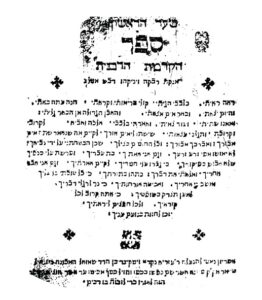
“The meaning of the menorah can also be such that a good woman is likened to it, just as a good woman is likened to our Torah, so that they may know that a good woman is equal in weight to the entire Torah. And just as the Torah cannot endure if even one letter is missing from it, so too a good woman must be whole in good deeds toward the Blessed Holy One and toward other people”.
(From the book ‘Meneket Rivkah’, with translation, introduction, and notes by Yemima Hovav,
Yedioth Books, fol. 6b)
Her exceptional figure
At the turn of the seventeenth century, Rebecca daughter of Meir Tiktiner of Prague composed the ethical book for women “Minneket Rivka”, a book in Yiddish consisting of thirty six pages. Despite its limited scope, its value should not be underestimated. This is the first book written by a Jewish woman, or at least the first that has been preserved and reached us, and therefore “Minneket Rivka” is a source of exceptional importance.
The biographical information about Rebecca daughter of Meir Tiktiner is scarce. On her tombstone in the ancient cemetery in Prague it was written:
Rebecca daughter of the honorable our teacher the rabbi R’ Meir Tikatin / passed away on the twenty fifth of Nisan according to the reckoning this stone Rebecca may her soul be bound in the bundle of life / many daughters have done valiantly but you surpassed them all / her husband trusted in her heart like Abigail in her lifetime by her merit she protected him / a whole offering like a ram in death she was given as atonement / she would expound day and night to women in every faithful community / the eye of everyone who went out and came in flowed with tears when she was hidden away and buried
From these words it עולה that Rebecca daughter of Meir passed away in the year 365 according to the small count 1605, and that her father, who is not known to us from other sources, was a learned man and a native of the town of Tikotin near Bialystok in northeastern Poland.
The description on the tombstone that she was expounding day and night to women in every faithful community is reinforced by the Yizkor prayer for the elevation of her soul in the pamphlet of the Altneuschul synagogue in Prague:
May God remember the soul of the elderly rabbanit Mrs. Rebecca daughter of the honorable our teacher the rabbi Meir, because her husband the rabbi R’ […] gave charity, and she also expounded in every […]. For this merit may her soul be bound in the bundle of life with the souls of Abraham Isaac and Jacob, Sarah Rebecca Rachel and Leah, with the rest of the righteous and righteous women in the Garden of Eden, and let us say amen.
These words of remembrance teach several additional details about the life of Rebecca daughter of Meir. She passed away at an advanced age, although we do not know how old she was at her death and therefore cannot know her year of birth. She passed away before her husband, whose name was apparently Bezalel Baruch or Bezalel Henukh, and no rabbinic title was attached to his name. From this it follows that the title rabbanit attached to her likely hints at her own qualities as a learned woman who was well versed in sacred literature, rather than to her being the wife of a rabbi. Moreover, unlike many women who devoted themselves to the service of God during their widowhood, some of whom chose to withdraw from worldly life and some of whom even went up to the Land of Israel, Rebecca daughter of Meir engaged in her religious and public activity while she was married.
The printer Gershom son of Bezalel wrote further words in her praise at the opening of her book:
Since you knew the important woman, the rabbanit and preacher Mrs. Rebecca of blessed memory, daughter of the genius the honorable our teacher the rabbi Meir Tiktiner of blessed memory, who conceived and wrote this book. All her intention was for the fear of God day and night, and her thought was not for honor. Who has ever heard or seen such a novelty, that never before occurred, that a woman would compose a book from her own mind and herself read verses and midrashim. Therefore I printed it, so that any woman who wishes to read it may buy it for herself. And she called the book Minneket Rivka so that it would be a memorial and an honor for all women. For a woman too can compose words of ethical teaching and good interpretations just like many men.