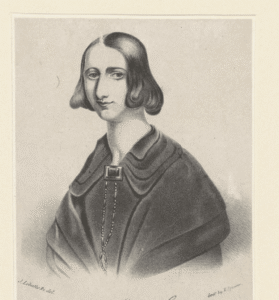
By Maya Spielman
“The Torah was not written solely for its learned commentators, but for every human being.”
from the introduction to The Women of Israel (1845)
Grace Aguilar (1816–1847) was a British Jewish author, poet, biblical commentator, and theologian of Sephardi-Portuguese descent. Though her life ended at the young age of 31, she left a remarkably rich legacy that became a foundation for modern Jewish women’s thought. It is known that she published about twelve major works, many of which were translated and widely circulated around the world.
Aguilar was born into a family descended from Portuguese conversos. Her parents had fled Portugal despite the dangers of the Inquisition, which continued there until 1821. The family carried with them a deep memory of hidden Judaism, persecution, and the struggle to preserve identity. This traumatic background, combined with the Victorian environment of London, shaped Aguilar’s thought and inspired her lifelong focus on courage,
faith, and Jewish women’s renewal.
Aguilar developed an extraordinary love for the Bible. This connection stemmed largely from her mother, Sarah Aguilar, who read Scripture with her regularly and in great depth. These readings left a strong imprint on her mind and became the seed of her interpretive method.
For Aguilar, the Bible was not only a legal text. She saw it as profound poetry, a landscape of human emotion and spiritual longing. This approach allowed her to uncover the feminine journey within the ancient stories, turning Scripture into a “book of life” for every woman.
Her writings call upon women to recognize their inner strength and to take pride in their identity. Aguilar argued that many limitations placed on women throughout Jewish history, including restrictions shaped by the Talmudic era, were the result of a people preoccupied with survival, persecution, and exile.
But in nineteenth-century London, she wrote, a woman “sitting in a beautiful dress” and free to practice her faith openly could now learn, influence, and reclaim her place. Women, she insisted, must step beyond the old social categories of “slave, minor, and fool” and return to their rightful spiritual and communal standing.
.