Share:

Facebook
LinkedIn
WhatsApp

Golda Meir:
A Prayer for my people
and the people of the world  

Golda Meir, former Prime Minister of Israel, is not perceived by the public as a praying figure. On her first visit to the Western Wall after the Six-Day War, she wrote a small note with one word: “Peace.” A leader seeking not only power and victory, but also a deep prayer
for a better future. 

Golda Meir – A Prayer from within Leadership

Golda Meir, the fourth Prime Minister of Israel, is remembered as a determined political figure, “the only woman in the government.” Yet alongside her public strength remained rare moments in which her spiritual, inner, and profound world was revealed. Moments of prayer.

On her first visit to the Western Wall after the Six-Day War, when the plaza was still narrow and full of paratroopers wrapped in prayer shawls and clinging to the stones, she described how young soldiers stood, wept, and prayed. There, within the historic national event, Golda wrote a small note with only one word: “Peace,” and tucked it between the stones of the Wall.

Few know Golda Meir through this lens, as a leader for whom prayer was an expression of a deep, for the people of Israel and for the entire world.
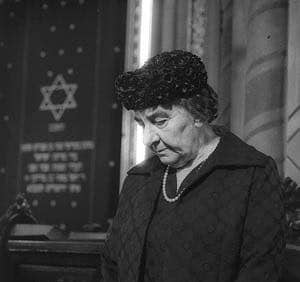

Prime Minister Golda Meir during a Friday night prayer service at the “Coral” synagogue in Bucharest, Romania.
Photo: Moshe Milner. 
These were the words Golda Meir shared at the ceremony in which she received the title “Worthy Citizen of Jerusalem” in 1971, about her first visit to the Western Wall after its liberation:

“I decided that it was impossible not to be in the Old City and not to go to the Western Wall… And that Friday morning, we went with soldiers. And there, not in the wide plaza of today,
but in that narrow place, a simple table with some submachine guns upon it, and beside
it young men in paratrooper uniforms, wrapped in prayer shawls, clinging to the Wall and inseparable from it. They became one… They approached the Wall one by one and burst
into tears… Then I took a piece of paper, wrote the word ‘Peace,’ and tucked it between
the stones of the Wall.”

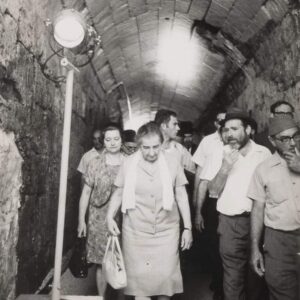
ביקור של גולדה מאיר במנהרות הכותל, באדיבות משפחת הרב שכטר
A visit of Golda Meir in the Western Wall tunnels. Photo: Courtesy of the Shechter Family

Golda Meir was appointed in the summer of 1948 as the first Israeli envoy to the Soviet Union. It was a dramatic role: to become the representative of the newly established state before one of the world’s great forces. Just days after her arrival in Moscow it was Rosh Hashanah 1949. Golda insisted on going to the Great Synagogue of Moscow, a step perceived by the regime as provocative, but for the Jews of the Soviet Union it became a moment of deep connection to the young State of Israel.

Hundreds and even thousands of Jews surrounded the synagogue, waiting to see the representative of the state that had just been born. That moment was engraved in historical memory as a peak of Jewish solidarity and as an opening of the door to renewed hopes.

Words by Golda Meir from her memoir ‘My Life’

“I shall never forget that day. I went to the synagogue, and when I arrived I found myself in a vast sea of people. Old men, women, young people, thousands who stood and looked at me. They could not speak freely, but their eyes said everything. I sat in the women’s section, and when my name was mentioned. Everyone turned to look at me, as if they wanted to imprint this moment in their memory.
On my way back, an old Jew approached me, touched my shoulder, and whispered in an almost inaudible voice: ‘Blessed are You, Lord… For granting us life, for sustaining us and for helping us to reach this day.’ At that moment I felt the power of the connection between the people of Israel and its state, a connection of tears and prayer.”


“Like my generation, so too this generation of Sabras will strive, struggle, make mistakes, and achieve accomplishments. Like us, they are dedicated in heart and soul to the development and security of the State of Israel and to the dream of a just society here.  They know that in order for the Jewish people to remain a people there must be a Jewish state in which they can live as Jews, not by grace and not as a minority. I am certain that they will bequeath honor to the Jewish people wherever it is, at least as much as we tried to bequeath it to them. It is not only a matter of religious commandments and customs. In my eyes, to be Jewish means, and has always meant, pride in belonging to a people that preserved its distinct identity for over 2000 years with all the torments and pain inflicted upon it. Those who could not withstand this and tried to cast off their Judaism did so, I believe, at the cost of their basic identity, impoverishing themselves in a way that arouses compassion.

I do not know what forms Jewish customs will take in the future, and I do not know how many Jews will express their Judaism in Israel and outside of it a thousand years from now. But I know that Israel is not merely some small besieged country in which three million people struggle hard to hold on. Israel is a Jewish state that came into being as a result of the longing, the faith, and the resolve of an ancient people. We who dwell in Zion are only a part of the Jewish nation, and not even its largest part. But because Israel exists, Jewish history has been changed forever, and in my deepest estimation there are few Israelis today who do not understand the full measure of their historical responsibility as Jews.” (Golda Meir, My Life)


About Us | Women's Prayer Project

The “Women’s Prayer” project began two decades ago as a book that documented and collected Jewish women’s prayers throughout history. The book, which became a bestseller, revealed an entire world that had almost disappeared from our sight – a breathing and vibrant Jewish-feminine space that reflects a Jewish life story that was almost never told through conventional historical tools.

Today, marking 20 years since the book’s publication, we are proud to expand the project to a new format of prayer cards, combining the ancient prayers together with images from a stunning Judaica collection (courtesy of the William Gross Collection, photography: Arnon Barmucha).

The cards are intended for daily use, personal contemplation, family ceremonies and community activities – they invite us to return and reconnect with the rich feminine tradition that passed from mother to daughter throughout the generations.

Our Books

Women’s Prayer Cards (Tefilat Nashim) We use cookies to ensure the website functions properly and improve user experience. You can choose which types of cookies to enable.
Cookie Selection


Join us for women's prayer

A connection to the Jewish story through women’s voices
Join to receive sources, prayers, rituals and stories from the Jewish female tradition.