Share:

Facebook
LinkedIn
WhatsApp

Prayer Without Words and the Henna Ceremony

There are women whose prayers were never written down. They pray through action,
in the light of the candles, in preparing the home, and in great faith.
Such is Esther Harush, the grandmother of Talia Levi, who was born in the town of Sttat
in Morocco and does not know how to read in Hebrew.
All her life she has prayed in her own way: lighting candles for the righteous every day,
hanging pictures of Baba Sali and the Abuhatzeira family on the wall as a symbol of protection,
holding hillulot, and giving out red bracelets as a segulah for blessing.

“I understood that my grandmother, who does not know how to read,
is one of the most prayerful
women I know. Her prayer is life itself,” Talia writes.

This is a living prayer without a fixed text, without an open book a prayer that exists through creating hands, a quiet voice, and the daily act of faith.
The Henna  Ceremony – A Prayer in Color and Material

“Among the customs my grandmother keeps with deep devotion, one ancient ceremony stands out.” A ceremony that many young women from various communities wish
to hold  the Henna (Hina) ceremony.

The name H( i )na carries a profound spiritual layer: the initials of the name Chana Challah, Niddah, Ner the three foundational commandments of the Jewish woman.
Three actions that are physical, earthly, and spiritual all at once, in which a meeting takes place between the sacred and the ordinary, between body and soul.

In Morocco, the ceremony was held on the evening before the daughter’s wedding,
usually on a Tuesday. It is a rite of passage from girl to woman, preparation for married life,
and entry into a world of spiritual responsibility.
That evening the women would gather, drink sweet tea, sing Judeo-Arabic songs,
and apply the red henna paste to the palms of the bride and the participants.
The red color was considered a symbol of joy, good fortune, and protection against the evil eye.

The bride wore “al-kashwa al-kbira”, “the great garment,” and with song and dance entered the circle of women. In those moments the prayer was not spoken aloud  it was colored with pigment, touched the body, and was sealed in faith.

The henna ceremony is not only an ancient custom; it is an expression
of prayer in the body, a prayer written through action and through the female voice.
In recent years, since my book Minhag Nashim (“Women’s Custom”) was published,
I have been receiving inquiries from young brides or from their mothers who are seeking information about the ceremony. Many young women are returning to the ceremony not out
of nostalgia, but out of a desire to connect to a feminine spiritual heritage,
to understand the generational blessing preserved within it.

“Suddenly I understood,” one woman wrote, “that I am not only being colored with henna,
I am joining a circle of women who prayed in this way hundreds of years before me.”

Testimony of Talia Levi, from the course Women’s Prayer at Bar-Ilan University, taught by Dr. Aliza Lavie.
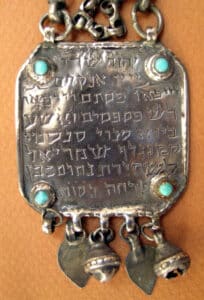
A silver amulet for protection, blessing, and fertility from North Africa, most likely from Morocco or Tunisia, from the 19th century. At the bottom are three pendants — two in the shape of a heart and one small bell — intended to “ward off the evil eye” and symbolize constant protection. Image courtesy of the Gross Family Collection.

About Us | Women's Prayer Project

The “Women’s Prayer” project began two decades ago as a book that documented and collected Jewish women’s prayers throughout history. The book, which became a bestseller, revealed an entire world that had almost disappeared from our sight – a breathing and vibrant Jewish-feminine space that reflects a Jewish life story that was almost never told through conventional historical tools.

Today, marking 20 years since the book’s publication, we are proud to expand the project to a new format of prayer cards, combining the ancient prayers together with images from a stunning Judaica collection (courtesy of the William Gross Collection, photography: Arnon Barmucha).

The cards are intended for daily use, personal contemplation, family ceremonies and community activities – they invite us to return and reconnect with the rich feminine tradition that passed from mother to daughter throughout the generations.

Our Books

Women’s Prayer Cards (Tefilat Nashim) We use cookies to ensure the website functions properly and improve user experience. You can choose which types of cookies to enable.
Cookie Selection


Join us for women's prayer

A connection to the Jewish story through women’s voices
Join to receive sources, prayers, rituals and stories from the Jewish female tradition.