Share:

Facebook
LinkedIn
WhatsApp

A mother’s prayer for the Bar Mitzvah

For this boy I prayed
Watch over this child for me here in this land and upon the face of the earth.
Please my God bestow upon him the blessing of heaven from above
From: A Mother’s Prayer for the Bar Mitzvah Boy, Fanny Neuda, 1855

What stands behind the Bar Mitzvah ceremony? Why specifically at the age of thirteen?
How did grandfathers and fathers used to lay tefillin? How was a Bar Mitzvah celebrated
in previous generations? Were special prayers written for this occasion? And what is the place
of the mother amidst all the preparations, the excitement, and the ceremony?

The Bar Mitzvah year is a year of journey. It is a special opportunity to explore family roots,
the customs and prayers of the community, the story of the communities from which we came,
and the meaning of the age of thirteen: a transition point between childhood and the yoke
of responsibility, between freedom and commandments, between family belonging
and Jewish responsibility.

At the center of this journey usually stands the boy: he learns to read from the Torah,
writes a sermon, prepares to lay tefillin, enters the community. But by his side stand his parents,
and very often his mother in particular, who organizes, worries, produces, gets excited,
holds all the ends together, and sometimes is left without a single moment in which her heart too can say what is on it.

Here enters the mother’s prayer.

When the mother asks for a place within the ceremony

In Jewish tradition the Bar Mitzvah ceremony developed around the son’s entry into the yoke
of commandments, belonging to the congregation, and religious and communal commitment. But for generations, almost no prayers were written for the mother at this moment.

The absence of formulated prayers in the prayer books opened a gate to personal, familial,
and renewed prayers. Specifically this empty space invited mothers, fathers, grandfathers, grandmothers, and sometimes the boys themselves, to seek words of their own.

Fanny Neuda identified this moment already in the mid nineteenth century.
She understood that a mother stands before her son on the day of his entry into commandments, and she does not always have a defined place within the ceremony,
but she has a prayer. She has gratitude. She has worry.

She has a longing for the childhood that is parting, and she has a great hope for the future.

In her prayer she gives a voice to the mother who sees her son entering the congregation
of Israel, and asks for him not only personal success, but purity of character, courage of spirit, devotion to good, responsibility toward the people and the land, and good deeds for the benefit of the public.

Her prayer for the mother at the time of her son’s reception of the commandments is among the most moving prayers in her book. It returns the mother’s heart to the center of the ceremony, not in place of the boy, but by his side. Not to diminish his status, but to illuminate the familial, spiritual, and feminine envelope within which he grew.

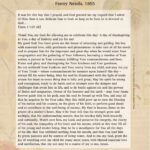
At Her Son’s Bar-Mitzva, Fanny Neuda, 1855

It was for this boy that I prayed, and God granted me my request that I asked of Him.
Now I, too, dedicate him to God; so long as he lives he is devoted to God…” (Sam. I 1:27-28)

Thank You, my God, for allowing me to celebrate this day!
A day of thanksgiving to You; a day of festivity and joy for me!
My good God, You have given me the honor of educating and guiding this boy
with maternal love, with gentleness and pleasantness; to take care of all his
needs and to prepare him for the important and great day when he would enter Your congregation and the gathering of Your followers, becoming a member
of Your nation, a partner in Your covenant, fulfilling Your commandments and laws.
Praise and glory and thanksgiving for Your kindness and Your goodness.
Do not withhold Your kindness and Your mercy from my child, and may the joy of Your Torah – whose commandments he assumes upon himself this day – always fill his entire being.
May his soul be illuminated with the light of truth; arouse his heart to every thing that is lofty
and great. May his spirit be strong
and courageous, ready to do battle and to triumph over the dangers and challenges that await him in life, and to do battle against sin and the powers of desire and temptation. Owner of the heavens and the earth – may Your Name forever guide him in his path, may his soul be bound up with You, and may all that he acquires be for Your sake. May this child grow up to earn the blessing of his nation and his country, to the glory of his faith, to perform good deeds and to contribute to the well-being of society. My God in heaven, listen to the prayer of a mother’s heart. May it be Your will that his strength grow and multiply, that his understanding mature, that he develop fully both inwardly and outwardly. Watch over him, my Lord, and preserve his integrity, the clarity of his soul, the tranquility of his heart and his nature, which at this time fill all of his young and tender being. May he be a mouthpiece for You all the days of his life, that You withhold nothing from his mouth, and that You lead him by green pastures and by sources of living water. And to me, my God, grant the joy of watching over my child for many more years, with blessed maternal love and satisfaction, that my son may be a source of joy to me, Amen.

A Jewish Woman’s Prayer Book, 2008, Aliza Lavie, Random House

An Ancient Prayer Returns to the Hearts of Mothers:

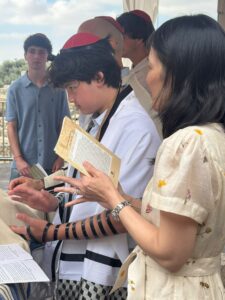
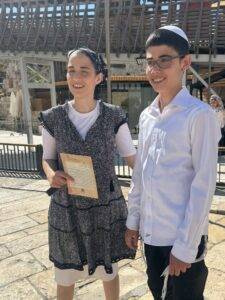
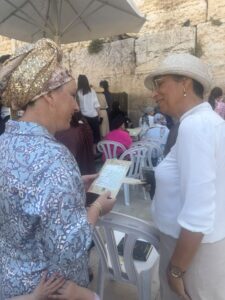
Through the initiative of Efrat Alter, the mother’s prayer for the bar mitzvah by Fanny Neuda is being distributed to mothers at the Western Wall.

To join, dedicate or support the initiative: info@tfilatnashim.com

From Fanny’s prayer to the book The Jewish Backpack

Inspired by Fanny Neuda and her prayer for the Bar Mitzvah mother, I wrote a prayer for my son Dror for the first time when he reached the age of commandments.
Out of this personal journey the book The Jewish Backpack was born.

At first it was a mother’s journey following her son’s Bar Mitzvah. Very quickly it became clear that this was not just a private journey.

It turned into a broad collection, gathering between its pages heritage from the four corners of the world: customs of fathers, heritage of mothers, communal and familial traditions, creative works, stories and prayers, alongside the longing of the generations. The diversity of the collection allows each and every one to take what their heart desires: boys standing before a Bar Mitzvah, mothers and fathers of young adolescents, grandmothers and grandfathers to grandchildren.
Those who wish to return to ancestral customs, will find a gateway in it. Those who are looking for ancient prayers or new works, will find a language in it. Those who seek knowledge, will find an open treasure in it.

Because a Bar Mitzvah is not merely an event. It is an invitation to a journey of identity.

A Mother’s Prayer: Aliza Lavie

“Even the sparrow has found a home, and the swallow a nest for herself, where she may have her young near Your altars, Lord of hosts, my King and my God.”

(Psalms 84:4)

I give thanks before You, King, living and enduring God, that You have made me Your partner for this child. For this boy I prayed.

Therefore I will thank You, for his life and for our lives which are entrusted in Your hand, for Your goodness at all times and for giving us what we asked of You. We, his father and his mother, bear a prayer to the God of the universe that He will guard his ways, protect his paths and guide him in the path of love, brotherhood and friendship.

God of our mothers, Sarah, Rebecca, Rachel and Leah, the good and beneficent God. I thank You that You heard the prayers of my pregnancy and listened to the pains of my labor, and blessed our family with the fruit of the womb and granted us the merit to bring him into the yoke of commandments at a good and successful hour.

May it be Your will, Lord of peace, that this boy, who comes today into the yoke of Your commandments and Your ways, merits true peace and everlasting love, liberty and freedom. And may it be Your will that all lands be redeemed and free without human subjugation at all. And may the boy be blessed in the congregation of Israel and in the whole world, and may his soul be blessed. May he merit to repair the world in Your kingdom in Your abundant goodness.

God of thanksgivings, may his prayer before You be blessed in peace and in perfection of character. Wrap this son of mine in holiness and purity and may we all merit, his parents, his siblings, his grandfathers and grandmothers, the members of his family and the dear congregation that is with us, to complete joy, to goodness of heart and to great blessing. And may the prayers of my parents and elders and the longings of all the generations be fulfilled in him.

And may it be Your will that my sins and iniquities will not withhold from him all the good in the world, an inheritance of knowledge and recognition of knowledge,

and may the heritage of my people stand for him, the customs of the exiles that gathered and came to our family from the four corners of the earth,

and above all – the instilling of the value of love of humanity.

Blessed is He who gave in His holiness Torah and liberty to His people Israel, blessed is He!

Blessed are You, Lord of all the worlds, blessed is the crown of Your glory, and blessed is the throne of Your kingdom! Grace us with the light of life, the hidden light of which it is said, “And God said, Let there be light, and there was light”, Amen, Selah and forever.

By the merit of my mothers and fathers, please turn to the requests of my heart, watch over this child for me here in this land and upon the face of the earth.

Please my God, bestow upon him the blessing of heaven from above. Make his days good “and may he find favor and good understanding in the sight of God and man”. “The least will become a thousand, and the youngest a mighty nation”. “You, Lord, in its time will hasten it”. And may he be before You “like a tree planted by streams of water, which yields its fruit in season and whose leaf does not wither, and whatever he does prospers”. And may his prayers always be accepted before You, and the requests of

all the members of Your people Israel at every time and at every hour in Your peace. And expand our borders in the study of Torah and give us length of days and years of life in love and in brotherhood and in peace to love Your holy name.

I am the woman standing before You my God, and casting my supplication and my prayer as every day. “From the straits I called upon the Lord, the Lord answered me in a broad place”.

And to me, my God, give the happiness to watch over my child and my family for many more years, with blessed motherly love and contentment, Amen.

Why do tears rise in my eyes again?

Because I am a mother, and mothers cry sometimes.

In the tears there is a little sadness over the parting from your childhood, and there is in them great happiness over our new partner, over the Bar Mitzvah boy who joins today the community of adults and the obligated.

I was the first who felt you, who heard you and listened to you in this world. From the first sound of your voice in the delivery room until your conversations and pursuits today, I know: for exactly this boy I prayed.

Smart and gentle, listening and voicing, knowing and opinionated, full of the joy of life and yet responsible and serious.

The radiance of your face is like the appearance of our family mosaic, which gathered and came from the four corners of the earth. There is similar and different in it,

and we are all one, despite the separation that was forced upon us for two thousand years.

I wish to utilize this special moment in your life, the transition point between childhood and the yoke of responsibility,

between freedom and commandments and responsibility, to tell you what is on my heart.

And on my heart, only love for you.

I see you and am happy.
I hear you and am overjoyed.
I think of you and the people of your generation, and am filled with good hope.

Aliza Lavie, (2013). The Jewish Backpack. [Heb]. Yediot Sfarim

Efrat Alter and the Mothers Prayer that Returned to the Western Wall

Sometimes an ancient prayer comes back to life through one single moment of a single mother.

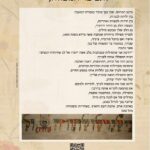
This is exactly what happened to Efrat Alter, who on the Shabbat of the bar mitzvah of her son Ariel was exposed to the moving prayer of Fanny Neuda for a mother whose son reaches the age of mitzvot. The words touched her heart with such great intensity that she initiated the printing of the prayer in Hebrew and English and its distribution to mothers celebrating a bar mitzvah at the Western Wall.

Since then, every time Efrat meets a mother preparing for the bar mitzvah of her son, she hastens to send her this special prayer. Dozens of mothers have already been blessed to receive it, and many of them have returned to express their deep gratitude for this unique spiritual gift, which gave them the words to express their emotions at such a meaningful moment in their lives and the lives of their sons.

Thus the prayer of Fanny Neuda continues to live, to touch hearts and to accompany mothers in our generation too, in the moments of prayer, gratitude and deep emotion of the bar mitzvah day.

And so she tells:

“My connection to Fanny Neuda started from a very personal story. When our son, Ariel, celebrated his bar mitzvah, we hosted the bar mitzvah Shabbat at a hotel in Jerusalem. The theme of the entire Shabbat was ‘Rejoice in the building of Ariel’ both our private Ariel, our beloved son, and Ariel in its deeper meaning: the Holy Temple.

We are a family of Kohanim, and our dream is that Ariel will merit with the help of God to serve in the building of the Holy Temple. The entire Shabbat was built around this idea. We opened it by going down to the Western Wall for Kabbalat Shabbat, and afterwards, when we went up to the hall, impressive displays of the Temple vessels from the Temple Institute were waiting there. Every festive meal and every word of Torah was woven around the theme: the personal maturity of Ariel alongside the yearning for the building of Jerusalem and the Holy Temple.

I had prepared in advance things I wanted to say. I invested a lot of thought into them, and I felt they were beautiful and precise. And then, a short time before Shabbat, I opened the book Womens Prayer by Aliza Lavie, and there I came across the prayer composed by Fanny Neuda for a mother whose son reaches the age of mitzvot. I read it and was moved to the depths of my soul.

I had a difficult dilemma. After all I had already prepared my own words. But eventually I said to myself: Efrat, why think that only from the words you wrote will your blessing come to Ariel? Here is a prayer that was said by generations of women before you. Connect to it. Let it speak.

On Shabbat morning, after the Kiddush, I stood before all the family members and friends. I hugged Ariel and began to read the prayer slowly, calmly, with attention to the words. When I finished, I raised my eyes. I saw my father pull out a handkerchief and wipe a tear. In my life I had seen him cry only once before, when his mother passed away. And he teared up…. And not only him. All around there was absolute silence. People were very moved. I felt that this prayer touched a deep place within all of us.

But the story did not end there. On Shabbat my husbands boss was also hosted by us, a man who had distanced himself greatly from Judaism, together with his partner and their two children. They were with us in all the experiences of the Shabbat at the Western Wall, at the meals, in the songs, in the family atmosphere. On Motzaei Shabbat his partner approached me and said: “This was a Shabbat I will not forget my entire life. But the thing that moved me most was what you said yesterday.” I smiled and said to her: “It was not yesterday at all. It was only this morning…” And she answered: “It does not matter when it was. This is the thing I am taking with me from the Shabbat.”

In my eyes, this is the power of the prayer of Fanny Neuda. At such a meaningful moment in the life of a mother, it allows her to connect not only to her son who stands at the threshold of adulthood, but also to an endless chain of Jewish women who stood at that same moment before her, carried those same prayers, and those same hopes. And I wish for every mother to merit this moment, to stand next to her son on the day of his bar mitzvah, and to feel how one prayer manages to bridge between generations, between hearts, and between the private individual and the entire people of Israel”.

Efrat Alter at the Western Wall with the Prayer for the Bar Mitzvah Mother

About Us | Women's Prayer Project

The “Women’s Prayer” project began two decades ago as a book that documented and collected Jewish women’s prayers throughout history. The book, which became a bestseller, revealed an entire world that had almost disappeared from our sight – a breathing and vibrant Jewish-feminine space that reflects a Jewish life story that was almost never told through conventional historical tools.

Today, marking 20 years since the book’s publication, we are proud to expand the project to a new format of prayer cards, combining the ancient prayers together with images from a stunning Judaica collection (courtesy of the William Gross Collection, photography: Arnon Barmucha).

The cards are intended for daily use, personal contemplation, family ceremonies and community activities – they invite us to return and reconnect with the rich feminine tradition that passed from mother to daughter throughout the generations.

Our Books

Women’s Prayer Cards (Tefilat Nashim) We use cookies to ensure the website functions properly and improve user experience. You can choose which types of cookies to enable.
Cookie Selection


Join us for women's prayer

A connection to the Jewish story through women’s voices
Join to receive sources, prayers, rituals and stories from the Jewish female tradition.